With mind-bending physics, spectacular combat, uneven storytelling and a thunderous commercial launch—more than 2 million copies sold in under 24 hours—Crimson Desert divides opinion, fascinates players and stands as one of 2026’s most distinctive open-world experiences.
Crimson Desert: key points to remember
- Game type: single-player open-world action-adventure with RPG elements, developed by Pearl Abyss (the creators of Black Desert Online).
- Worldwide release date: March 19, 2026, on PC (Steam, Microsoft Store), PS5 and Xbox Series X|S.
- Launch sales: more than 2 million copies sold in under 24 hours across all platforms.
- Major strengths: highly systemic physics, free exploration, varied traversal (dragons, mechs, climbing), and fast-paced, spectacular combat.
- Main weaknesses: uneven storytelling, very weak opening chapters, numerous visual bugs, an erratic camera and a cluttered interface.
- Target audience: players who prioritize gameplay, sandbox systems and challenge over an exceptionally strong story.
A red sun rises over Pywel
Night had long since fallen over Pailune when the Grey Mane riders finally appeared at the top of the hill. In the valley, the Black Bear torches drew a trembling line of fire, as straight as a blade ready to cut the world in two. Kliff—the weary leader of a company scattered by years of wars and debts—gripped his sword’s hilt more tightly, as if to smother his doubts. Behind him, his mercenaries whispered and made promises they perhaps already knew they could not keep: to reclaim their honor, atone for their mistakes and survive a night when everything suggested they would be crushed between forces far beyond their control. Before them, Pywel seemed to hold its breath: in the glowing forests, among forgotten ruins and even in the depths of the Abyss, where something ancient and evil was finally awakening. Crimson Desert does not begin like a bright tale of white knights.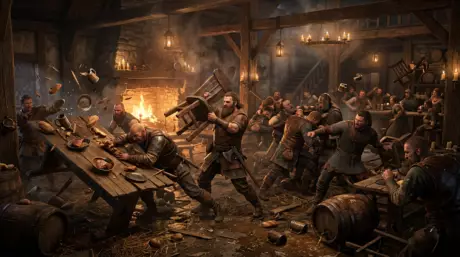 It is a story of mercenaries, bad contracts, betrayals and wars lost in advance, where every burned village leaves a new scar on the map and in the memories of those who survive. Kliff is neither the chosen one nor a kingdom’s last hope: he is an exhausted gang leader, a disillusioned warrior who is mainly trying to keep his people alive in a world that leaves no room for the weak.
What Crimson Desert actually is
Crimson Desert is an open-world action-adventure game developed and published by Pearl Abyss, the Korean studio already responsible for the MMO Black Desert Online. Initially conceived as a multiplayer prequel set in the same universe, the project gradually shifted toward a predominantly single-player experience centered on a story-driven campaign, while retaining a strong sandbox identity. The game runs on the BlackSpace Engine, Pearl Abyss’s proprietary technology, designed to render a huge world, an impressive draw distance and, above all, highly advanced physics: trees that can be cut down and carried, manipulable objects, partially destructible environments and cascading systemic interactions. This technical ambition places Crimson Desert among 2026’s major AAA productions.Release date, platforms and launch model
Simultaneous worldwide launch
Crimson Desert officially launched on March 19, 2026, with a simultaneous worldwide release. The announced launch times notably included 3 p.m. PDT, 6 p.m. EDT and 11 p.m. CET, meaning access became available on the morning of March 20 in some Asian and Oceanian territories. Pearl Abyss opted for a single global launch rather than a gradual regional rollout, putting all players on the same discovery timeline, with preloading available several days before release.Available platforms
Crimson Desert is a current-gen-only production: no PlayStation 4 or Xbox One version has been announced. The game is available on PC (Windows), PlayStation 5 and Xbox Series X|S, with separate stores and support depending on the platform.| Platform | Support / Store | Details |
|---|---|---|
| PC | Steam, Microsoft Store, GeForce NOW | Preload followed by worldwide launch on 03/19/2026; upscalers (FSR, DLSS…) supported depending on the configuration. |
| PlayStation 5 | Disc, PlayStation Store | Simultaneous launch, with several graphics modes (Performance, Quality, Balanced) detailed by Pearl Abyss. |
| Xbox Series X | Disc, Microsoft Store | Simultaneous launch, Performance/Balanced/Quality modes, dynamic resolution and ray tracing depending on the settings. |
| Xbox Series S | Microsoft Store (digital only) | Simultaneous launch, more significant compromises in resolution and graphics options, with no Balanced mode. |
Connectivity, day-one patch and offline play
On its first launch, Crimson Desert requires an internet connection to download and apply a day-one patch and check for updates, including on physical console versions. This dependency has reignited the controversy surrounding games that cannot truly be “played from the disc” without an update. Once this step is complete, the single-player campaign can be played entirely offline, although a connection remains necessary to download later patches. Crimson Desert therefore differs from Black Desert Online by remaining primarily a single-player experience without a permanent connection.Pywel: a continent of war, dust and the Abyss
The world’s major regions
Crimson Desert takes place on Pywel, a vast continent divided into distinct major regions such as Hernand, Pailune, Demeniss, Delesyia and the Crimson Desert itself, each with its own climate, architecture and factions. The world is presented as a seamless open world, with no visible loading screens between these areas. Pailune stands out for its autumn-colored forests—red and yellow—and carefully crafted lighting, while some desert areas are considered visually duller. Pywel combines gritty medieval realism (ravaged villages, famine and mercenary bands) with dark fantasy tied to the Abyss, a supernatural dimension threatening to spill into the real world.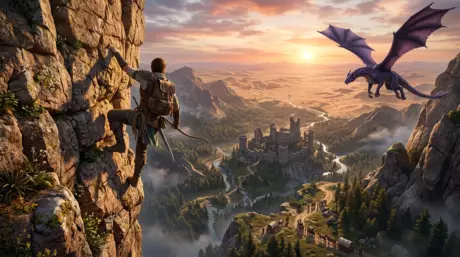
Factions, mercenaries and overall tone
The game features several rival groups, including the Grey Manes—Kliff’s company—and the Black Bears, who are responsible for a disastrous confrontation with the company at the beginning of the adventure. The tone is resolutely adult: blunt dialogue, graphic violence and a constant wartime atmosphere in which mercenaries survive by selling their services to the highest bidder.Kliff, the Grey Manes and an uneven story
The initial premise
The campaign begins by placing the player in control of Kliff, leader of the Grey Manes, a band of mercenaries already battered by life. An assault by the Black Bears shatters the group’s fragile balance, scatters its companions and stains the company’s honor. The game’s central thread rests on several clear goals: reunite the Grey Manes, restore the company’s name and standing, and become embroiled in intrigues that go far beyond a simple mercenary group.A mediocre narrative
The feedback converges on a highly uneven narrative, alternating soporific chapters with flashes of impressive staging. The first four or five chapters feel like a long tunnel of MMO-style tutorial quests, in which players follow NPCs to discover features such as arm wrestling, boxing and archery, including a quest focused on following a cat. From chapters 6–7 onward, the story picks up more momentum: certain quests stand out, including the “reed devil,” a mysterious crow and several anime-inspired battles, while the presentation begins to better convey what it means to lead a mercenary company. The lore is there, but remains too understated to give the game the scale of a major epic saga like The Witcher.Kliff, a somewhat underwhelming hero
Kliff divides opinion: beyond his design, it is above all his personality that causes problems. He says little, drops a few punchlines and then falls silent, making him feel like a rather hollow protagonist compared with companions such as Yan or Dwayne, who are considered more memorable and better characterized. The dialogue’s tone, however, is clearly adult: the characters swear, tease one another and speak like adults in a harsh world, which fits the game’s rough mercenary atmosphere well.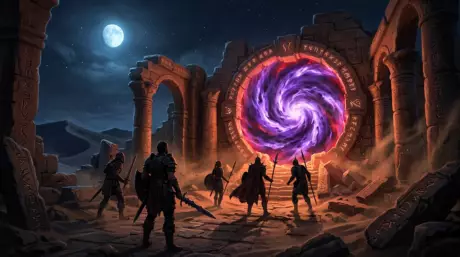
An open world that is genuinely enjoyable to explore
Free exploration without constant backseating
While the narrative is divisive, the open world and exploration are among the elements receiving the most consistent praise. Many environmental puzzles require observation, experimentation and thought, without a companion automatically shouting the solution after ten seconds. Some puzzles can hold a player’s attention for tens of minutes or even hours, provided they refuse to look up a walkthrough, and the game fully embraces this approach. When a tower, cave or ruin catches the eye in the distance, Crimson Desert often rewards simple curiosity—at least with a challenge, and sometimes with a genuine secret.A challenge that encourages exploration
Crimson Desert offers only one difficulty level. There is no easy mode to breeze through the game: charging straight through the main quest without stopping to gear up, explore and solve a few puzzles quickly leads to being obliterated by certain enemies or bosses. The game therefore strongly encourages players to seek better weapons, armor and artifacts, search for secrets and hidden areas, and gradually grow stronger to withstand what comes next in the campaign.Physics, mobility and the joy of “playing with the world”
Traversal and verticality
Crimson Desert offers an unusually broad range of traversal options for an open world of this size: horses and land mounts, rideable dragons, a jetpack, imposing rocket-equipped mechs, free climbing, a magical double jump and a grappling hook for clearing obstacles or launching yourself into the arena. This variety turns traversal itself into a source of enjoyment rather than a simple transition between two fights, strengthening the game’s verticality and sense of constant adventure.A systemic sandbox
The BlackSpace Engine enables a level of physics that very few open worlds can currently match: players can cut down a tree, pick it up and use it as a club; throw barrels, crates or NPCs at enemies; use the environment as a ramp or projectile; and destroy many objects inside buildings. The game thus becomes a genuine generator of absurd, funny or tragic emergent situations. With this level of physics in an open world of this scale, Crimson Desert has practically no current equivalent.Design limitations: rewards, NPCs and shallow systems
Exploration is not always rewarded enough
Exploration is not perfect: some difficult-to-reach locations or well-hidden caves occasionally lead to a simple chest containing a few coins. For a game that encourages thorough searching so strongly, many players would have liked more meaningful rewards—unique equipment, memorable artifacts or additional lore—to make every detour worthwhile.Rigid NPCs and strange crime systems
NPC behavior exposes the system’s limitations: it is possible to break into someone’s home in the middle of the night and steal items with minimal reaction, while in other cases the player can be wanted for an assault that nobody could logically have witnessed.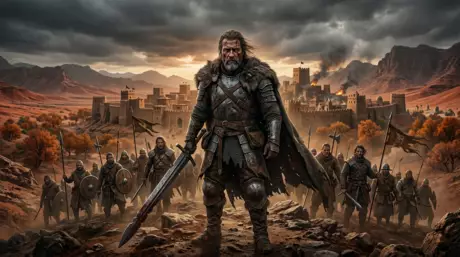 Day and night, routines remain fairly rigid and lacking in variety, harming immersion and making the world feel less alive than it could be given the richness of its physics.
Underused housing and camp systems
Crimson Desert offers an upgradeable camp and a house to decorate, intended to add a sense of home amid the chaos, but these systems are considered superficial. The house mainly serves as a decorative space, without truly meaningful functions such as a central inventory-management chest. The game thus accumulates numerous systems—housing, crime, minigames and town activities—without always giving them sufficient depth, reinforcing the feeling of a project that is spread too thin.Combat: a deep, fast-paced and spectacular system
Feel and creativity
Combat is one of the game’s major strengths, with a dynamic system rich in combos and experimentation. Players have access to numerous weapons and special abilities, and can use the world’s physics to throw objects, propel themselves over barricades or chain together wrestling moves, finishers and spectacular contextual attacks. The AI is relatively aggressive, readily attacking in groups to surround the player, which makes some encounters demanding. The impact of attacks, particle effects—which can be disabled—and finishing animations contribute to a sense of power considered far greater than that of many recent open-world AAA games.Usability, camera and “health sponge” bosses
On a controller, the abundance of commands and lack of complete remapping make the initial learning curve difficult. Once that hurdle is overcome, the combat system reveals its depth, but the camera can cause problems during large melees, sometimes getting stuck against walls or moving too close to the character. Many bosses are criticized for being “health sponges”: enormous health bars artificially prolong encounters at the expense of pacing, although certain scripted fights, such as the one against the “reed devil,” clearly stand out.Art direction, music and atmosphere
Biomes and aesthetics
Artistically, Crimson Desert alternates between magnificent sequences and much more ordinary areas. Pailune, with its golden and red forests bathed in carefully crafted light, is often cited as one of the most successful biomes, while some desert environments leave a flatter impression. The aesthetic combines European medieval influences with Asian touches, a distinctive color palette and strongly differentiated biomes, but the visual experience varies dramatically depending on the areas visited.Soundtrack and voice acting
The soundtrack is one of the game’s universally praised elements: the opening themes, exploration music and tracks associated with certain biomes or battles greatly enhance immersion. Pailune’s theme and several epic battle tracks are regularly highlighted by reviewers. The English voice acting is considered convincing, but the lack of French voice acting may disappoint some French-speaking players. The dialogue’s blunt, direct tone emphasizes the harshness of mercenary life and contributes to the game’s adult atmosphere.Technology: an ambitious engine with visible flaws
PC performance
Crimson Desert runs on the proprietary BlackSpace Engine, designed to deliver a long draw distance, a high density of detail and advanced physics. On high-end PCs, the game can reach 4K at a high frame rate while handling numerous lighting and particle effects. On a system such as an RTX 3060, i5-12400F and 32 GB of RAM at ultra settings, reports indicate a frame rate between 50 and 60 FPS, demonstrating reasonable optimization for this level of hardware.Popping, shadows and flickering
At the same time, visual problems are numerous: extensive popping of grass, bushes and trees at short distances, textures that take time to load, shadow bugs and flickering distant elements. These issues coexist with generally successful lighting effects, particularly through windows and during nighttime scenes. NPCs can float above their chairs, some objects appear to be made of “Styrofoam” because they break so easily, and debris disappears quickly to preserve performance, reminding players of the technical compromises at work.Console versions: caution advised
Several content creators advise caution regarding the PS5 and Xbox Series versions because of mixed signals about the quality of these ports and the prolonged absence of console gameplay footage before release. The most common advice is to wait for detailed feedback and a few patches before paying full price on these platforms.Accessibility, interface and usability
Crimson Desert’s interface is dense: its many menus, submenus and equipment-, ability- and activity-related information may overwhelm some players during the first few hours. On a controller, the lack of complete remapping combined with the high number of commands makes the initial learning curve rough. The tutorials sometimes blur into uninspired quests, creating the impression of narratively empty missions primarily designed to introduce the game’s features. Over the long term, this way of presenting the systems contributes to the feeling that the opening chapters are padded out, before the game truly opens up its more interesting activities.Length and content structure
Crimson Desert is a massive game: around 70 to 80 hours to complete the main quest while taking some time to breathe, and potentially several hundred hours for completionists who want to explore, solve and experience everything. This generosity nevertheless heightens the feeling of padding in certain areas, with a proliferation of enemy camps to clear and very conventional side quests involving deliveries or location-clearing.Sales: a very strong start
Despite its flaws, Crimson Desert has achieved an impressive commercial launch. Pearl Abyss announced that the game had surpassed 2 million copies sold worldwide in under 24 hours after release, across all platforms. This figure has been reported by numerous media outlets and communities, which cite the studio’s official statements and social media posts. For a new IP in a market saturated with open worlds, this is a highly significant performance.Critical reception and player perception
Critically, Crimson Desert has received a generally positive welcome, but is far from the masterpiece status some expected. Aggregators such as Metacritic placed it at around 78/100 at launch, equivalent to a strong 15/20. Many reviewers emphasize that Crimson Desert “fails for the right reasons”: its ambition is too broad, it has too many systems with insufficient depth in some cases, average writing, but a genuine love of video games behind it.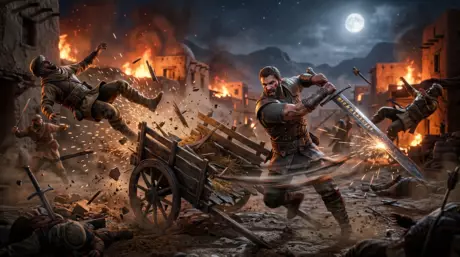 Among players, the game has a mixed rating on Steam, with criticism aimed at the interface, controls, bugs and certain design choices, while another part of the audience praises the exploration, world density, playful physics and genuine sense of adventure.