World of Warcraft in 2026: Why Blizzard's MMORPG Remains Essential
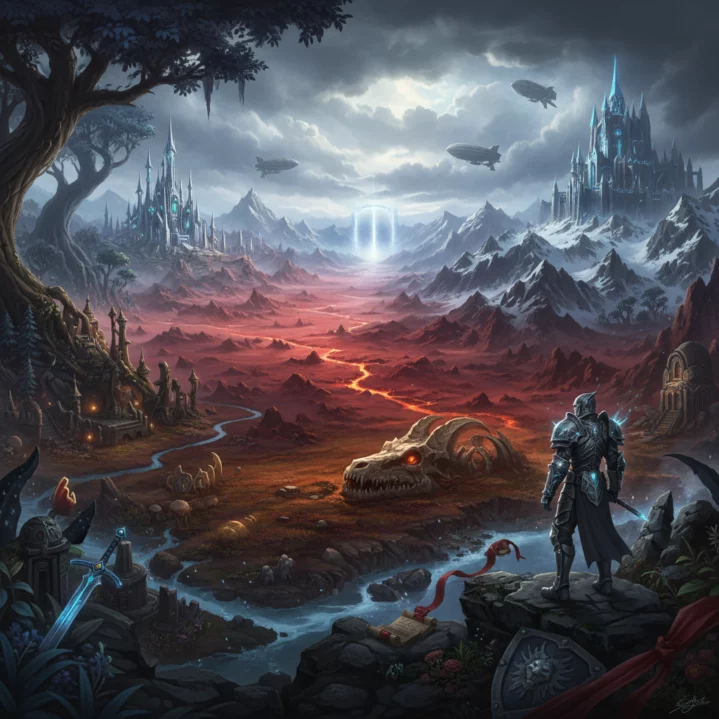
Since its release in November 2004, World of Warcraft has redefined MMORPG standards and shaped an entire industry. Twenty years later, Blizzard Entertainment's game continues to attract millions of players through regular expansions, its expansive universe and its Retail/Classic dual offering. A complete analysis of this cultural phenomenon in 2026.
Why does World of Warcraft remain essential?
World of Warcraft celebrated its 20th anniversary in November 2024 with the release of The War Within, the first part of the Worldsoul Saga. Far from running out of steam, the game enjoyed a massive resurgence of interest driven by WoW Classic's success and the return of long-time players attracted by nostalgia and refreshed Retail content. Its longevity rests on three fundamental pillars.
- Twenty years of lore: Azeroth is one of the best-documented fictional worlds in gaming — novels, comics, cinematics and quests build a coherent and absorbing mythology.
- Constantly evolving gameplay: Every expansion substantially reworks progression systems, classes and combat mechanics to prevent routine from setting in.
- An exceptional global community: Guilds, raids, PvP and auction houses — WoW is as much a social space as it is a game, something few titles have matched.
The game's current momentum
The monthly subscription model (~€13) provides stable development funding without relying on intrusive advertising. Though often criticized, this model remains justified by the volume of content produced: biweekly patches, Mythic+ seasons, new raid wings, seasonal events and weekly balance updates.
Blizzard has also made the game more accessible with a free trial that allows players to reach level 20 with no time limit. This approach lets new players discover the first zones, dungeons and class mechanics before making any financial commitment.
Technical and Gameplay Analysis in 2026
World of Warcraft's engine has received several major graphical overhauls since 2020. The latest improves the rendering of characters, environments and spell effects while maintaining exemplary compatibility with a wide range of hardware configurations — an absolute priority for a game with a global player base.
Performance and hardware accessibility
| Component | Minimum | Recommended |
|---|---|---|
| OS | Windows 10 64-bit | Windows 11 64-bit |
| CPU | Intel Core i5-3450 / AMD FX 8300 | Intel Core i7-8700K / AMD Ryzen 5 2600 |
| RAM | 8 GB | 16 GB |
| GPU | NVIDIA GTX 760 / AMD RX 560 (4 GB VRAM) | NVIDIA RTX 2060 / AMD RX 5700 XT (8 GB VRAM) |
| Storage | 100 GB (HDD) | 100 GB (SSD recommended) |
Gameplay changes in The War Within
The War Within introduces several major innovations to WoW Retail's gameplay loop. The Delves system offers instanced dungeons for solo players or small groups, bridging the gap between casual content and Mythic+. Hero Talents add a third optional specialization for each class, providing unprecedented customization without undermining the overall balance.
- Delves system: Scalable instanced content playable solo — ideal for players without an active guild.
- Hero Talents: A third thematic specialization tree inspired by iconic characters from the franchise.
- Warband: Progression shared between your alternate characters — reputation, banks and certain rewards are shared.
- Underground: A new main region featuring vertical exploration and areas to discover gradually.
Mythic+ and endgame progression
The Mythic+ system remains the core of endgame progression for most players. These time-limited dungeons, with variable difficulty levels (2 to 20+) and rotating weekly affixes, offer an almost endless progression curve. Combined with raids at Normal, Heroic and Mythic difficulties, WoW offers one of the richest endgame programs in the MMORPG genre in 2026.
Undeniable Impact on the Video Game Industry
World of Warcraft is not merely the most popular MMORPG in history — it is the game that defined the genre's conventions and influenced dozens of subsequent titles. At its peak in 2010, the game had more than 12 million active subscribers, a record never matched in the genre.
The innovations WoW popularized
- Guided questing: Before WoW, most MMORPGs left players to fend for themselves. WoW introduced contextual quests with clear objectives, a standard that is now universal.
- Cross-server play: Looking for Group (LFG) and later Looking for Raid (LFR) popularized automatic matchmaking in MMORPGs.
- Raids as a social pillar: Raids for 40, then 25 and 10 players established guilds as essential social structures in online gaming.
- The regular expansion model: An expansion every 18–24 months remains the industry norm for maintaining a subscriber base.
The high expectations of a demanding community
The WoW community is among the most passionate and critical in the industry. Every Blizzard design decision is analyzed in depth on the official forums, Reddit and guild Discord servers. This intense engagement is paradoxically a strength: it pushes the studio to maintain high standards and respond to community feedback through regular blue posts and rapid balance adjustments.
WoW Retail vs WoW Classic: Two Complementary Experiences
The coexistence of WoW Retail and WoW Classic is one of Blizzard's major strategic successes. Included in the same subscription, the two versions target distinct player profiles without cannibalizing one another.
| Criteria | WoW Retail (The War Within) | WoW Classic Era / Cataclysm |
|---|---|---|
| Progression pace | Fast, supported by the Warband system | Slow, every level matters |
| Endgame content | Mythic+, Delves, Mythic Raids | 40-player raids, PvP Battlegrounds |
| Class complexity | Modernized, with Hero Talents | Original, fewer buttons but more specialization choices |
| Atmosphere | Narrative, cinematic, epic | Community-focused, nostalgic, demanding |
| Target audience | All player types, casual to hardcore | Veterans and players seeking authenticity |
Final Verdict
✓ Strengths
- The richest and best-documented MMORPG universe — 20 years of consistent lore.
- Retail/Classic dual offering included in one subscription — exceptional value.
- The War Within: Delves and Hero Talents deeply refresh the gameplay loop.
- Mythic+ is one of the genre's best endgame programs.
- Active global community and abundant resources (Wowhead, Warcraft Logs, Raider.IO).
- Excellent hardware accessibility — runs on modest systems.
✗ Points to consider
- Monthly subscription required — cumulative cost over time.
- Learning curve for new players without guidance: the lore and systems can be overwhelming.
- Additional paid bank tabs and character services on top of the subscription.
- Retail remains behind Classic in terms of purely organic community and social interaction.
Our verdict — 9.2 / 10
World of Warcraft is one of the most important works in video game history. In 2026, The War Within demonstrates that Blizzard has not lost its ability to reinvent a title two decades after its release. If you have never explored Azeroth — or if you left it behind — there has never been a better time to return. A landmark title that fully deserves its place at the top of the MMORPG genre.
FAQ — World of Warcraft
What makes World of Warcraft so popular after 20 years?
WoW's popularity rests on 20 years of coherent lore, constantly evolving gameplay and an exceptional global community. Regular expansions and WoW Classic keep veterans and newcomers interested.
Do you need a subscription to play World of Warcraft?
Yes, a monthly subscription (~€13) is required to access the full range of content, including WoW Retail and WoW Classic. A free trial allows players to reach level 20 with no financial commitment.
What is the difference between WoW Retail and WoW Classic?
WoW Retail offers the current game with The War Within and all its modern systems. WoW Classic recreates the original 2004 experience. Both are included in the same subscription and appeal to different types of players.
Can you play WoW without having followed the previous expansions?
Yes. Chromie Time lets you choose an expansion to start with and progress at your own pace. Each expansion is designed to be accessible independently, with its own narrative introduction.