While the galaxy far, far away continues to amaze us with new productions, it is time to take a look at a modern classic: LEGO Star Wars: The Force Awakens. Released a decade ago, this title adapted from the film of the same name immersed us in the post-Trilogy universe. But in 2026, with hindsight and technical advances, does this brick-by-brick journey still deserve our attention, or has it been consigned to the archives of the forgotten Force? We put our smuggler boots back on for a no-holds-barred verdict.
Familiar gameplay, but refined?
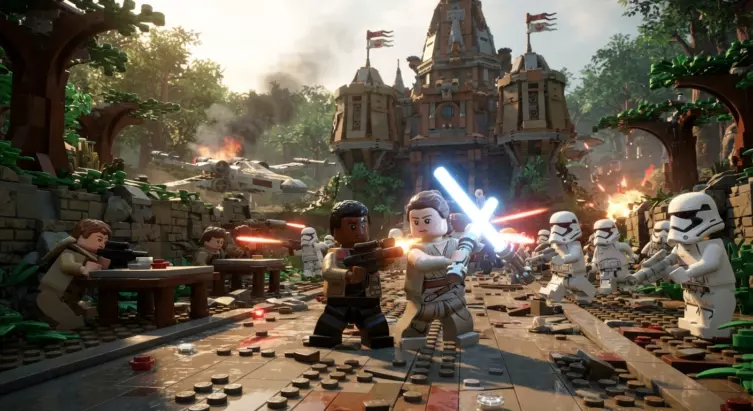
From the very first minutes, you find the tried-and-tested LEGO formula: exploration, small co-op puzzles to solve, and of course, destroying everything that can be destroyed to collect thousands of studs. But The Force Awakens tried to add its own touch of novelty with “Multi-Builds.” This mechanic allowed us to build several different objects from the same pile of bricks, opening the way to more varied puzzle solutions. On paper, it was an excellent idea that added a little depth to the usual one-way building sequences.
However, with the benefit of hindsight in 2026, we realize that while the intention was commendable, the execution was often limited. “Multi-Builds” were sometimes more of a formality than a genuinely creative puzzle-solving mechanic. We still enjoy the space combat sections, which deliver a healthy dose of action and throw us into the heart of the film’s iconic battles, even if they can become repetitive over time. The cover system, another new feature at the time, added a semblance of strategy to firefights, but it did not turn the game into a tactical shooter either. All in all, the game remains solid entertainment for fans, but it does not reinvent the LEGO gameplay wheel, especially when compared with the ambitions of more recent titles.
The story and its LEGO adaptation
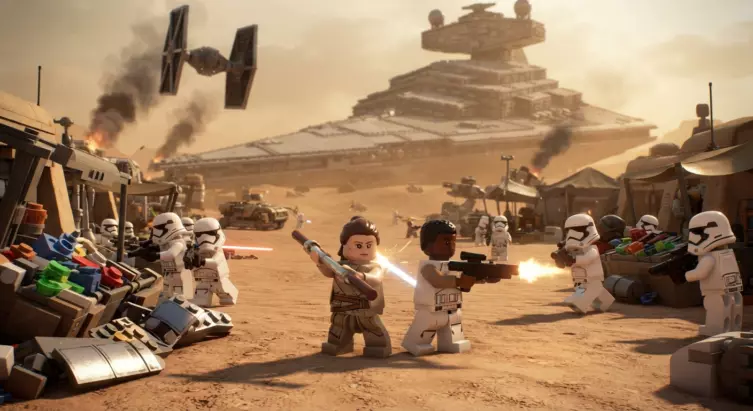
One of this title’s greatest strengths is undoubtedly its faithful and hilarious adaptation of J.J. Abrams’ film. TT Games managed to inject its signature humor into every scene, turning dramatic moments into memorable gags. Watching Kylo Ren throw a brick-built tantrum, or BB-8 behave like a mischievous dog, is still a treat. The game does not merely follow the film to the letter; it also includes previously unseen scenes, narrative “bridges” that explain certain events or characters between Episodes VI and VII. That is a real bonus for fans of the expanded universe.
Yet that faithfulness also has its limits. While the plot is well conveyed, it remains very linear. You follow the film from beginning to end, without much freedom to explore or make choices that could have enriched the experience. Although open areas are present, they are more like hubs for accessing levels than genuine worlds to explore in depth. We would have liked a little more boldness in the narrative or mission structure to really move beyond the simple “interactive movie.” Still, for a LEGO game, the balance between respect for the original work and a humorous touch is well judged.
Additional content and playtime: a long-term investment?
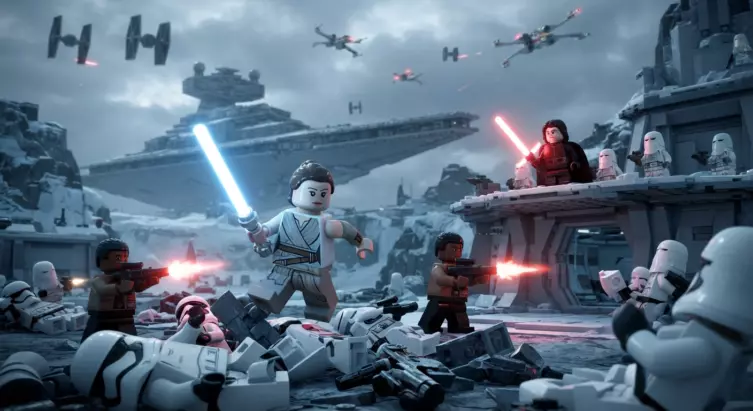
While the main campaign of LEGO Star Wars: The Force Awakens can be completed in around 8 to 10 hours, the game’s real appeal lies in its colossal additional content. The Season Pass, already covered at the time in our pages, offered no fewer than 6 additional DLC levels, each expanding the story with unseen scenes or revisiting key events between Return of the Jedi and The Force Awakens. These levels, such as “The Rathtar Hunt” and “The Siege of Takodana,” are often among the strongest in the package, offering varied challenges and exclusive characters.
For completionists, reaching 100% represents an investment of around 25 to 30 hours of gameplay, or even more. Between collecting Minikits and gold bricks, unlocking hundreds of characters and vehicles, and completing the specific challenges in every level in Free Play mode, there is plenty to do. However, it is impossible to ignore the fatigue that can set in when replaying the same levels to find that final secret. Some Season Pass character packs, while enjoyable for fans, did not bring genuine gameplay variety. It is worth noting that the game, tested on PC via Steam in 2026, runs flawlessly at a steady 60fps, even on modest systems, which is welcome for a title of this age. You can find more information about the game and its DLC on its official Steam page.
Technology and accessibility in 2026
Visually, LEGO Star Wars: The Force Awakens shows its age. The character models and environments, while faithful to the LEGO aesthetic, lack the polish and detail found in more recent productions such as LEGO Star Wars: The Skywalker Saga. Textures are sometimes simplistic, and the lighting effects, although functional, cannot compete with current standards. However, the charm still works thanks to LEGO’s timeless art direction and the Star Wars universe. The user interface remains clear and functional, though its design is a little dated.
Accessibility is an undeniable strength. The game is designed for everyone, from younger players to older ones, with intuitive controls and an ever-effective split-screen co-op mode. It is an excellent title for sharing some fun with family or friends. The soundtrack, featuring John Williams’ iconic themes, is an absolute delight and makes a major contribution to immersion. Despite its obvious technical limitations in 2026, the experience remains smooth and enjoyable, even if we regret that the game has not received significant graphical updates over the years. For Star Wars purists, the Star Wars wiki is an excellent resource for exploring the story’s details further.
Strengths and weaknesses
What we liked
- LEGO’s humor remains as effective as ever — turning the film into an irresistible comedy.
- A faithful and expanded adaptation of the story — with highly welcome unseen scenes.
- The Season Pass’s substantial additional content — significantly extending the game’s lifespan.
- Accessible gameplay and co-op mode — perfect for family gaming.
What we liked less
- Gameplay that lacks innovation — the LEGO formula is beginning to show its limits without meaningful renewal.
- Visuals that feel dated in 2026 — making it difficult to compete with current standards.
- A degree of repetition in the pursuit of 100% completion — the grind can become tiresome.
- The main campaign’s linearity — limiting exploration and freedom.
Verdict
So, should you pick up LEGO Star Wars: The Force Awakens in 2026? If you are a die-hard Star Wars and LEGO games fan, the answer is a cautious yes. The game offers a fun and faithful retelling of the film, with enough content to keep you busy for several dozen hours. However, you should be aware that time has taken its toll: its mechanics are less surprising than they were at the time, and its visuals show their age.
It is therefore aimed at nostalgic players, younger gamers discovering the LEGO Star Wars universe, or anyone looking for a simple, hassle-free co-op experience. For everyone else, its appeal may be more limited, especially alongside newer and more ambitious LEGO productions. It is a good game, but not an absolute must-play in 2026. It remains an entertaining snapshot of an era and a great gateway for younger players into a galaxy far, far away.