It is available on
Xbox One, PS4 and PC. Also coming soon to
PS3 and Xbox 360.
Shadow of Mordor is the best
Lord of the Rings game in nearly 10 years—and considering the competition, that is saying something. More importantly, it is much better than you might expect. That does not just mean that you will get your share of thrills, set pieces and innovation.

It has a lot in common with other
Warner Bros. franchises: the
Batman: Arkham Asylum / City / Origins series. This is another open-world adventure that emphasizes combat and stealth. Although it contains elements of
Assassin's Creed in its stealth finishers and all manner of acrobatics, it is much less focused on exploring urban environments. Meanwhile, the forceful combat and heavy melee counterattacks bring it closer to Batman's style, right down to the slow-motion finish when you kill the last enemy in a group. Shadow of Mordor brings something new to the genre; even if the whole system initially looks like a gimmick, it turns out to be surprisingly deep.
The environment and character design are 99% WETA and Peter Jackson, but the plot reaches deeply into Tolkien's backstory. As a result, the story of a
Gondor ranger torn from death to avenge his murdered family has richer implications than you might initially expect. The key characters from the saga are used in the game and not treated lightly, and anyone who has studied the
Silmarillion will probably have a few reservations. Those who love
The Lord of the Rings,
The Hobbit and the film adaptations will find that Shadow of Mordor feels like a natural extension of the saga.

Your character is
Talion, a ranger tasked with defending the walls surrounding Mordor when
Sauron returns to life. Bad timing. His fort is overrun by orcs, and his wife and son are killed by a mysterious figure known only as the Black Hand of Sauron. Talion himself is also struck down. However, the torment of death does not turn out to be the end. Instead, he finds himself trapped in a kind of limbo: alive, but bound to the spirit of a long-dead elven lord, condemned to return to life until he can avenge his own people. He is somewhat like Bill Murray's character in
Groundhog Day. Unfortunately, Talion does not relive the same day in a small town in the United States; he finds himself in Mordor, wandering around and killing orcs.
The only hope for our hero to find peace is to kill the Black Hand. But how can he find this evil sorcerer? The answer turns out to lie in murder within the ranks of the
Uruk-hai: slaughtering captains, commanders and finally the war chief at the top. To do this, he must identify his targets, but there are several ways to achieve his goal. The first is to interrogate the people directly below them, working your way up the chain of command. The other is to use the services of a Machiavellian, albeit unfortunate, war chief who is almost an endearing coward.

Several assassination missions, infiltrations, multiple battles and the occasional traditional boss fight put all of Talion's interesting and varied skills to the test. Like the stars of
Assassin's Creed, he can sneak behind orcs and stab them in the back, or climb to a high point and leap onto them. He can also swing from a ledge and stab them from below, or use his supernatural bow to kill them from a distance. This is where the game feels most Creed-like, going so far as to use the same automatic acrobatic paths when you hold down the button.
When all else fails, he can take on the orcs one-on-one. Unfortunately for him, the odds are not exactly in his favor. As in the
Batman games, you will often find yourself surrounded by several enemies. Quickly use counterattacks at the right moment to parry incoming blows, then retaliate with powerful, swift strikes. If you can, finishers are available to deliver the killing blow to your enemies.

At first, combat is an anarchic brawl. You will find yourself attacked by too many orcs and spending too much time countering to land a decent hit. On top of that, finishing moves seem to take an enormous amount of time, leaving you vulnerable to attack if they break your counter. In Middle-earth, it seems that the camera is awful from certain angles, and combat can be exasperating.
Persevere, however, and put things in the right places. Be smart: learn to isolate targets or reduce their numbers with stealth, then attack with a bow. You also increase your power by using XP and the local currency to buy additional skills. These let you land critical hits, chain a paralyzing magical attack into a flurry of blows, or scatter enemies with a sweeping strike. Add environmental options, such as insect swarms that confuse orcs or exploding barrels that reduce their numbers, and the action becomes much easier later on.
Meanwhile, every death effectively plays its own role in the gameplay. Shadow of Mordor uses something called the "Nemesis System," in which the ranks of the orcs you massacre are not static. They change as orc captains develop more or less powerful traits, whether they die at your hands or at the hands of one of your rivals. Defeat an orc captain and he might return from the dead seeking revenge. Die, and the captain who killed you might be promoted; even ordinary orcs can rise through the ranks if they kill you. As orcs gain rank, their power grows too and, unfortunately, they become harder to kill. On the positive side, a dead captain will often drop a rune that you can add to your sword or dagger. The more powerful the captain, the more powerful the rune, making it worthwhile to kill higher-ranking orcs.
All the orcs you have encountered before remember you, and this makes them distinctive. If they have vile personalities, it shows, making the game strangely alive. Nothing makes you want to kill an orc more than a sarcastic comment after it has dealt you a fatal blow. You are not simply fighting another faceless group of orcs; you are trying to kill the orc bastard who killed you last time, or the one you know is after your head. More than a gimmick, the Nemesis System proves to be an excellent idea.

The system also feeds into broader gameplay. Each orc captain has their own strengths and weaknesses, which you can discover by interrogating agents who serve them. You may find that some are invulnerable to stealth or ranged attacks, while others become weaker if you can attack them while they are riding a snarling Caragor—the closest thing to a faithful steed in Mordor.
Beyond murder, you can sink your teeth into other activities. Finding, climbing and "reforging" ghostly wraith towers gives you more respawn points and fast-travel locations, while unlocking new missions in the region. Completing combat challenges earns cash that you can use to buy new skills or upgrade your weapons. Herbs and items can be discovered: the former provide healing, while the latter unlock lore. Meanwhile, two completely different story mission paths have you follow a familiar face to finally discover the identity and history of your new ghostly ally, or work with a band of escaped human slaves and outcasts ready to wage a guerrilla war against the orcs.
Many of these flaws are familiar to fans of open-world games. Like
Assassin's Creed, Shadow of Mordor can feel heavily driven by its systems; there is always plenty to do, but some of it becomes repetitive over time. Being overwhelmed by endless waves of orcs can be annoying when you are simply trying to kill a captain, and it is up to you to make sure you do not end up in situations you cannot handle. Riding a Caragor should be one of the game's highlights, but your snarling, orc-chomping mount is difficult to control. Meanwhile, Mordor—as you might expect—is not exactly the most picturesque place to explore.
Voir la vidéo sur YouTube
Although the graphics are remarkably detailed and rich on next-gen consoles, we are talking about a land of rain-battered gray rock, steep gray mountains, weathered gray ruins and ugly orc fortresses. It all creates an atmosphere, but it is also relentlessly bleak.
Fortunately, if the landscape is not particularly dynamic, your orc enemies are. Their speech varies at times, and they croon vulgar songs, petty rhymes and whines. It is almost a shame to kill them. With enemies like these, who needs a plot?
Voir la vidéo sur YouTube
Verdict: It looks like
a Middle-earth caught between Arkham City and Assassin's Creed, but the
Nemesis System helps transform Shadow of Mordor into something much more entertaining. With solid, demanding combat, it is often better to be stealthy when killing enemies. It is far more enjoyable than you might expect, and it treats the license with a certain amount of respect too. Has this year's sleeper hit landed? Do not bet against it.

 It has a lot in common with other Warner Bros. franchises: the Batman: Arkham Asylum / City / Origins series. This is another open-world adventure that emphasizes combat and stealth. Although it contains elements of Assassin's Creed in its stealth finishers and all manner of acrobatics, it is much less focused on exploring urban environments. Meanwhile, the forceful combat and heavy melee counterattacks bring it closer to Batman's style, right down to the slow-motion finish when you kill the last enemy in a group. Shadow of Mordor brings something new to the genre; even if the whole system initially looks like a gimmick, it turns out to be surprisingly deep.
The environment and character design are 99% WETA and Peter Jackson, but the plot reaches deeply into Tolkien's backstory. As a result, the story of a Gondor ranger torn from death to avenge his murdered family has richer implications than you might initially expect. The key characters from the saga are used in the game and not treated lightly, and anyone who has studied the Silmarillion will probably have a few reservations. Those who love The Lord of the Rings, The Hobbit and the film adaptations will find that Shadow of Mordor feels like a natural extension of the saga.
 Your character is Talion, a ranger tasked with defending the walls surrounding Mordor when Sauron returns to life. Bad timing. His fort is overrun by orcs, and his wife and son are killed by a mysterious figure known only as the Black Hand of Sauron. Talion himself is also struck down. However, the torment of death does not turn out to be the end. Instead, he finds himself trapped in a kind of limbo: alive, but bound to the spirit of a long-dead elven lord, condemned to return to life until he can avenge his own people. He is somewhat like Bill Murray's character in Groundhog Day. Unfortunately, Talion does not relive the same day in a small town in the United States; he finds himself in Mordor, wandering around and killing orcs.
The only hope for our hero to find peace is to kill the Black Hand. But how can he find this evil sorcerer? The answer turns out to lie in murder within the ranks of the Uruk-hai: slaughtering captains, commanders and finally the war chief at the top. To do this, he must identify his targets, but there are several ways to achieve his goal. The first is to interrogate the people directly below them, working your way up the chain of command. The other is to use the services of a Machiavellian, albeit unfortunate, war chief who is almost an endearing coward.
 Several assassination missions, infiltrations, multiple battles and the occasional traditional boss fight put all of Talion's interesting and varied skills to the test. Like the stars of Assassin's Creed, he can sneak behind orcs and stab them in the back, or climb to a high point and leap onto them. He can also swing from a ledge and stab them from below, or use his supernatural bow to kill them from a distance. This is where the game feels most Creed-like, going so far as to use the same automatic acrobatic paths when you hold down the button.
When all else fails, he can take on the orcs one-on-one. Unfortunately for him, the odds are not exactly in his favor. As in the Batman games, you will often find yourself surrounded by several enemies. Quickly use counterattacks at the right moment to parry incoming blows, then retaliate with powerful, swift strikes. If you can, finishers are available to deliver the killing blow to your enemies.
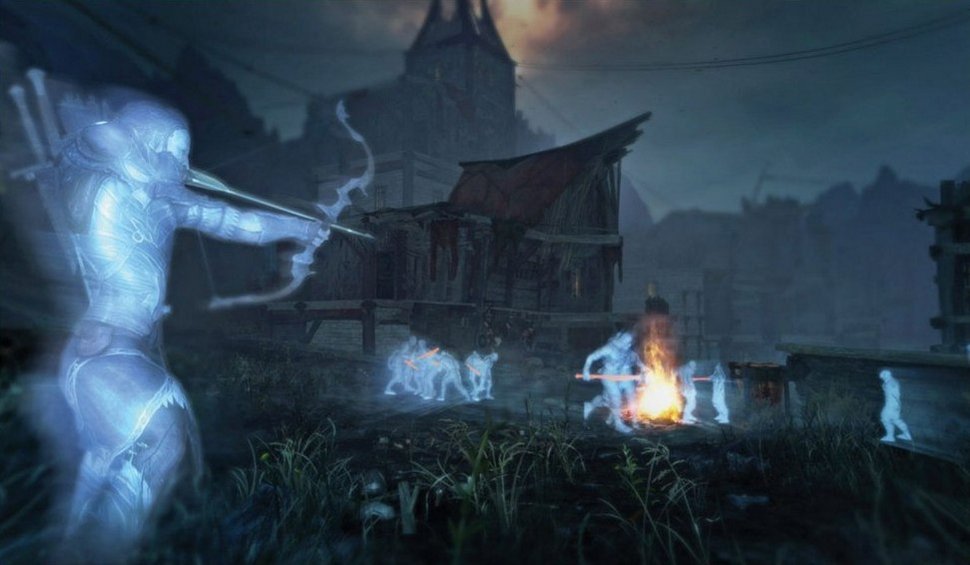 At first, combat is an anarchic brawl. You will find yourself attacked by too many orcs and spending too much time countering to land a decent hit. On top of that, finishing moves seem to take an enormous amount of time, leaving you vulnerable to attack if they break your counter. In Middle-earth, it seems that the camera is awful from certain angles, and combat can be exasperating.
Persevere, however, and put things in the right places. Be smart: learn to isolate targets or reduce their numbers with stealth, then attack with a bow. You also increase your power by using XP and the local currency to buy additional skills. These let you land critical hits, chain a paralyzing magical attack into a flurry of blows, or scatter enemies with a sweeping strike. Add environmental options, such as insect swarms that confuse orcs or exploding barrels that reduce their numbers, and the action becomes much easier later on.
 Meanwhile, every death effectively plays its own role in the gameplay. Shadow of Mordor uses something called the "Nemesis System," in which the ranks of the orcs you massacre are not static. They change as orc captains develop more or less powerful traits, whether they die at your hands or at the hands of one of your rivals. Defeat an orc captain and he might return from the dead seeking revenge. Die, and the captain who killed you might be promoted; even ordinary orcs can rise through the ranks if they kill you. As orcs gain rank, their power grows too and, unfortunately, they become harder to kill. On the positive side, a dead captain will often drop a rune that you can add to your sword or dagger. The more powerful the captain, the more powerful the rune, making it worthwhile to kill higher-ranking orcs.
All the orcs you have encountered before remember you, and this makes them distinctive. If they have vile personalities, it shows, making the game strangely alive. Nothing makes you want to kill an orc more than a sarcastic comment after it has dealt you a fatal blow. You are not simply fighting another faceless group of orcs; you are trying to kill the orc bastard who killed you last time, or the one you know is after your head. More than a gimmick, the Nemesis System proves to be an excellent idea.
 The system also feeds into broader gameplay. Each orc captain has their own strengths and weaknesses, which you can discover by interrogating agents who serve them. You may find that some are invulnerable to stealth or ranged attacks, while others become weaker if you can attack them while they are riding a snarling Caragor—the closest thing to a faithful steed in Mordor.
Beyond murder, you can sink your teeth into other activities. Finding, climbing and "reforging" ghostly wraith towers gives you more respawn points and fast-travel locations, while unlocking new missions in the region. Completing combat challenges earns cash that you can use to buy new skills or upgrade your weapons. Herbs and items can be discovered: the former provide healing, while the latter unlock lore. Meanwhile, two completely different story mission paths have you follow a familiar face to finally discover the identity and history of your new ghostly ally, or work with a band of escaped human slaves and outcasts ready to wage a guerrilla war against the orcs.
Many of these flaws are familiar to fans of open-world games. Like Assassin's Creed, Shadow of Mordor can feel heavily driven by its systems; there is always plenty to do, but some of it becomes repetitive over time. Being overwhelmed by endless waves of orcs can be annoying when you are simply trying to kill a captain, and it is up to you to make sure you do not end up in situations you cannot handle. Riding a Caragor should be one of the game's highlights, but your snarling, orc-chomping mount is difficult to control. Meanwhile, Mordor—as you might expect—is not exactly the most picturesque place to explore.
Although the graphics are remarkably detailed and rich on next-gen consoles, we are talking about a land of rain-battered gray rock, steep gray mountains, weathered gray ruins and ugly orc fortresses. It all creates an atmosphere, but it is also relentlessly bleak.
Fortunately, if the landscape is not particularly dynamic, your orc enemies are. Their speech varies at times, and they croon vulgar songs, petty rhymes and whines. It is almost a shame to kill them. With enemies like these, who needs a plot?
Verdict: It looks like a Middle-earth caught between Arkham City and Assassin's Creed, but the Nemesis System helps transform Shadow of Mordor into something much more entertaining. With solid, demanding combat, it is often better to be stealthy when killing enemies. It is far more enjoyable than you might expect, and it treats the license with a certain amount of respect too. Has this year's sleeper hit landed? Do not bet against it.