Editorial note — updated November 19, 2026. Rockstar sets the GTA VI unlock for midnight local time on November 19 on PS5 and Xbox Series X|S; the Associated Press reports the first gameplay sessions in New Zealand. Rockstar's commercial page still shows "pre-order" at the time of our check. This report distinguishes official announcements from journalists' observations. Game.fr has not directly tested GTA VI.
In 1997, all it took was a stolen car, a pixelated street, and an approaching siren to lose an hour in Grand Theft Auto. The camera looked down on the city from above. You guessed the facades more than you admired them. Yet, that feeling of heading off in a random direction, missing your turn, and seeing a simple drive turn into a chase was already there.
Twenty-nine years later, GTA VI brings us back to Vice City, in the state of Leonida, following Jason Duval and Lucia Caminos. The evolution of GTA is not just about graphics: it affects how Rockstar designs its cities, writes its characters, tunes driving, and transforms player freedom into personal stories. Here is the story from GTA 1 to GTA 6, highlighting the truly significant turning points and the first press observations on the latest episode. Setting and characters: Rockstar Games.
In brief. GTA 1 established in 1997 the loop of car–crime–police–escape. GTA III gave this freedom a 3D city. Vice City gave it a musical and narrative personality; San Andreas expanded the playground; GTA IV tightened the focus on physics and a darker story; GTA V combined three heroes and a second life with GTA Online. GTA VI brings Vice City to the present, in Leonida, around the duo Jason–Lucia. Early reviews describe a more central relationship and a highly detailed territory.
Table of contents
- The timeline of major GTAs
- On which platforms to play the different GTAs?
- The 2D, 3D, and HD universes
- GTA 1 and GTA 2: roots seen from above
- GTA III: the city becomes a place
- Vice City and San Andreas: identity and territory
- GTA IV: the weight of reality
- GTA V: three lives and a decade online
- GTA VI: announcements and first observations
- GTA V vs GTA VI and the two Vice Cities
- Maps, characters, police, vehicles, and music
- Is GTA really becoming more realistic?
- Side episodes and expansions
- Which episode transformed GTA the most?
- FAQ
- Historical and critical sources
The timeline of major GTAs
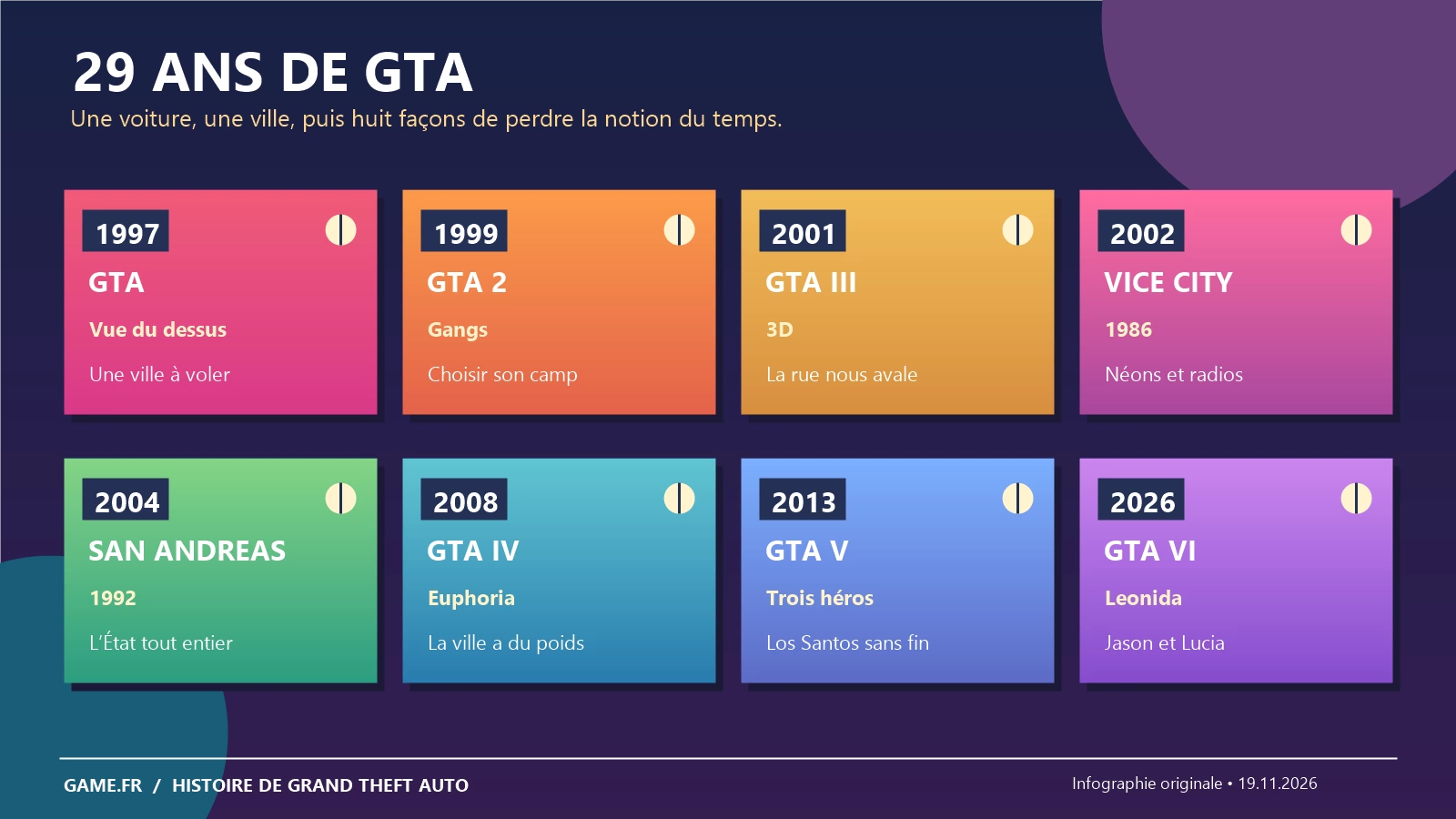
| Game | Initial release | Main world | Character(s) | The big leap forward |
|---|---|---|---|---|
| Grand Theft Auto | 1997 | Liberty City, San Andreas, Vice City | Selectable avatars | Criminal freedom and top-down police chases |
| GTA 2 | 1999 | Anywhere City | Poorly characterized protagonist | Gangs, missions, and reputation |
| GTA III | 2001 | Liberty City | Claude | 3D city explorable on foot and by car |
| Vice City | 2002 | Vice City | Tommy Vercetti | Era, soundtrack, and defined hero |
| San Andreas | 2004 | State of San Andreas | Carl "CJ" Johnson | Three cities, countryside, and customization |
| GTA IV | 2008 | Liberty City | Niko Bellic | Realistic physics, animation, and tone |
| GTA V | 2013 | Los Santos and Blaine County | Michael, Franklin, Trevor | Three protagonists; launch of GTA Online |
| GTA VI | 2026 | Leonida, including Vice City | Jason Duval, Lucia Caminos | Return to Vice City in the present day, story focused on a duo |
How to read this table? The years indicate the initial releases of the main games listed here, not the periods depicted: Vice City takes place in 1986 and San Andreas in 1992. These two games are included in this timeline because their contribution to the formula is major, even though they don't have a number. The GTA VI line summarizes its confirmed setting; the gameplay observations cited later are attributed to critics who have tried it. Portable episodes and expansions are mentioned further below. Rockstar dates the universes of Vice City and San Andreas.
On which platforms can you play the different GTAs?
The console on which a GTA was originally released is not necessarily the one where you can buy it today. The three cities from the PS2 era, for example, have received PC and Xbox versions, then a remastered trilogy: playing Vice City on Switch is not exactly the same as launching the 2002 PS2 disc. Here are the confirmed options as of November 19, 2026, without confusing ports, remasters, and backward compatibility.
| Game | Original platforms | Current verified option |
|---|---|---|
| Grand Theft Auto | PC, PlayStation; then Game Boy Color | No current confirmed digital purchase in the stores checked; prefer a compatible copy and machine for the original. |
| GTA 2 | PC, PlayStation; then Dreamcast and Game Boy Color | Same caution: old editions exist, but their current digital sale is not established here. |
| GTA III | PS2; then PC and Xbox | The Trilogy – The Definitive Edition on PC, PS4, PS5, Xbox One, Xbox Series X|S, and Nintendo Switch. |
| Vice City | PS2; then PC and Xbox | The same remastered trilogy on PC, PlayStation, Xbox, and Nintendo Switch. |
| San Andreas | PS2; then PC and Xbox | The same remastered trilogy on PC, PlayStation, Xbox, and Nintendo Switch. |
| GTA IV | PS3, Xbox 360, and PC | Complete Edition on PC; Xbox 360 version playable on Xbox One and Xbox Series X|S via backward compatibility. No native PS5 version verified. |
| GTA V | PS3 and Xbox 360; then PS4, Xbox One, and PC | Current editions on PC, PS5, and Xbox Series X|S; Rockstar also offers PS4 and Xbox One. |
| GTA VI | PS5 and Xbox Series X|S at launch | These two console families are the only ones announced by Rockstar. No PC, Switch, or Switch 2 version announced as of this date. |
On PC, the easiest way to rediscover the 3D trilogy is through its remastered version on Steam or the Rockstar Games Launcher.GTA IV: Complete Edition and GTA V are also offered. The first two GTAs did have PC editions, but a historic platform does not guarantee either a current digital purchase or an easy installation on a modern computer. Rockstar profiles for GTA 1 and GTA 2.
On PS5 or Xbox Series X|S, you can play through the remastered trilogy and GTA V in dedicated versions. Rockstar details the platforms for the trilogy and those for GTA V. On Xbox, the French profile for GTA IV also indicates its playability on Xbox One and Series X|S: this is the Xbox 360 era game running via backward compatibility, not a remaster. GTA VI is announced for PS5 and Xbox Series X|S.
On Nintendo Switch, the official option is The Trilogy – The Definitive Edition : GTA III, Vice City and San Andreas. On Switch 2, Nintendo explains that many Switch games run via backward compatibility, but some have restrictions; you must check the title's compatibility before purchase. We found neither a native Switch 2 edition of this trilogy nor any announcement of GTA VI on a Nintendo console; our update on the GTA 6 Switch 2 rumor details what is speculation. In other words, "GTA on Switch 2" here means the possibly compatible Switch version, never a confirmed port of GTA VI.
Three universes: 2D, 3D, and HD
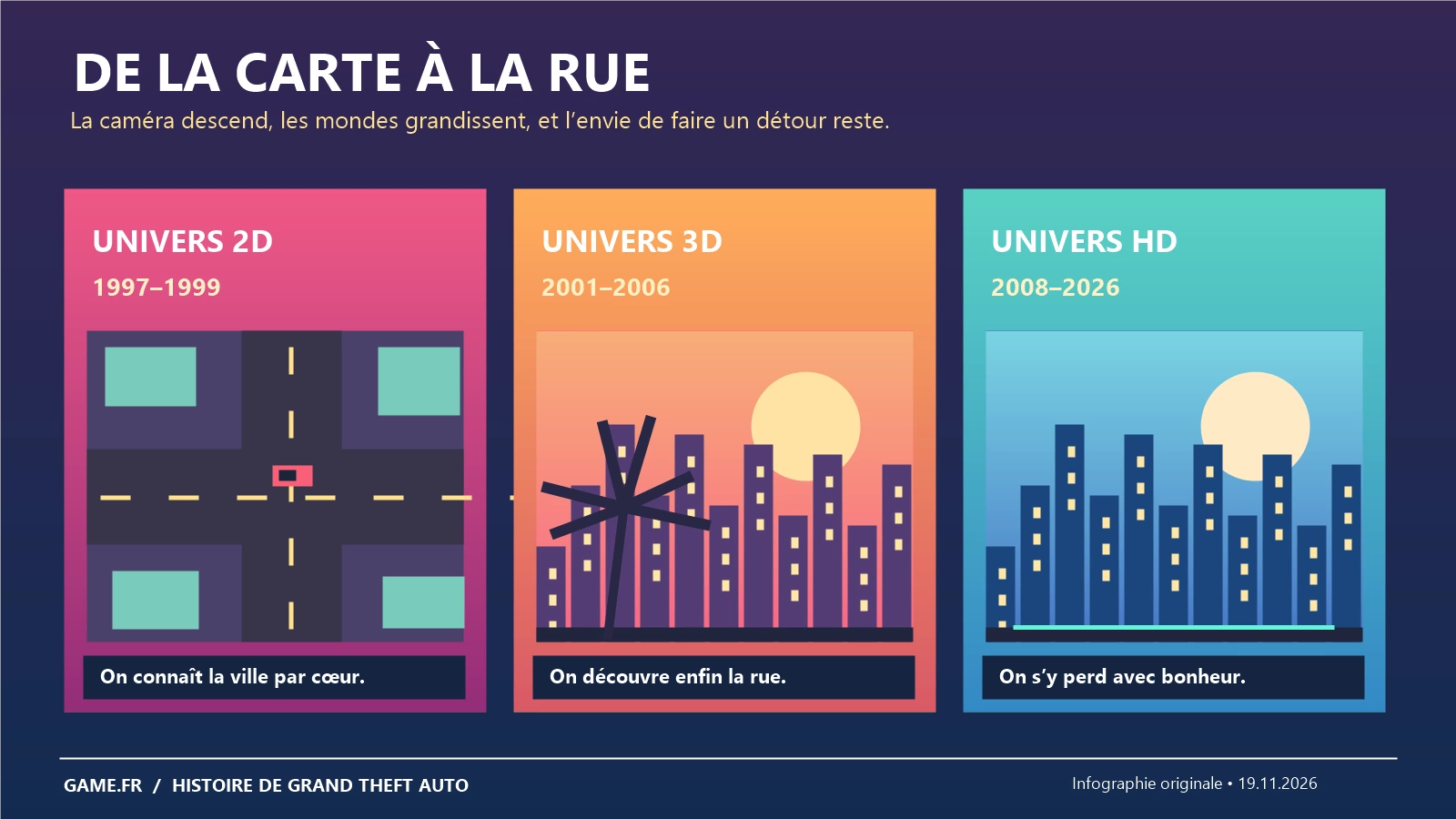
| Continuity | Main and related episodes | What you need to understand |
|---|---|---|
| 2D Universe | Grand Theft Auto, GTA 2, GTA London 1969/1961 | The first cities and their geographical variations. |
| 3D Universe | GTA III, Vice City, San Andreas, GTA Advance, Liberty City Stories, Vice City Stories | A continuity of characters and locations specific to the PS2 era and its extensions. |
| HD Universe | GTA IV and its two episodes, Chinatown Wars, GTA V, GTA Online, GTA VI | Familiar cities are reinterpreted in a different continuity. |
These names designate narrative continuities, and not just graphic styles: Chinatown Wars belongs to the HD universe despite its particular perspective. Similarly, recognizing "Liberty City" or "Vice City" does not mean finding exactly the same city, the same biography, or the same characters from one universe to another. Rockstar retains names, themes, and nods, then rebuilds its world according to the game's era. This distinction prevents taking Tommy Vercetti's Vice City for a simple unchanged neighborhood of Leonida.
GTA 1 and GTA 2: the roots seen from above
GTA in 1997: freedom before spectacle
Launching the first Grand Theft Auto, developed by DMA Design, a studio that became Rockstar North, is to rediscover a strange comfort in its roughness. The city is made of flat color blocks, traffic resembles a small mechanical ballet, and characters barely exist outside their function. Then you get into a car. An objective appears, a collision draws attention, the police get involved. The game immediately stops being a planned route: it becomes your anecdote. Take-Two traces the studio's name change.
The three city names, Liberty City, San Andreas, and Vice City, are already there. They do not yet have the cultural depth they will later acquire. The pleasure comes from a space you freely cross, where you can accept a mission or simply see where the road leads. The top-down view limits staging; it also makes the map immediately readable. You play with the city like a circuit whose rules can be disrupted.
The police are part of this formula from the start. An offense changes the pace: in the first GTA, the wanted level appears as police head icons, and the route turns into an escape. GTA 2 keeps these icons; stars will later become the most recognized sign of chases in the series. This is the founding loop: steal, act, attract attention, flee, repeat. History of wanted indicators in GTA 2.
| Element | GTA, 1997 | GTA VI, announced information |
|---|---|---|
| Point of view | Top-down view, abstract representation | 3D world shown by Rockstar |
| Heroes | Poorly developed avatars | Jason and Lucia, presented by Rockstar |
| Narrative | Brief missions and dialogues | Story announced around the duo and a criminal case |
| Territory | Three stylized cities | Vice City and other regions of Leonida |
| Police | Police head icons for wanted level | Chases observed in press tests; detailed comparison to be tested by Game.fr |
This table does not claim to mechanically measure the "freedom" of the two games. It shows what technology allowed to represent, then what writing chose to make of it.
GTA 2: a future already looking at factions
GTA 2 keeps the aerial camera but transforms the setting into Anywhere City, a city without a clear era, almost retro-futuristic. The memory it leaves is not only of chain explosions or cars sliding between intersections. It is also its gangs, their divergent interests, and a reputation that influences accessible missions. Working for one group can harm relations with another.
This idea adds depth to a city still represented simply. The player is no longer just a troublemaker amid traffic; they position themselves in a power struggle. This system does not resemble, in detail, the social relations of later GTAs. However, it shows that the series experimented very early with the consequences of choices. Game.fr analysis: GTA 2 is perhaps the most underrated episode when recounting the franchise's evolution. Behind its 2D silhouette, it already tests a modern question: who benefits from your next mission?
GTA III: the city becomes a place
Which GTA introduced 3D into the main formula?
GTA III, released in 2001, marks the decisive shift of the series to a 3D city explored from street level. Precision matters: GTA III did not invent the open-world game. It gave a generation of players a particularly convincing way to move around, between driving, walking, missions, radio stations, and surprises. Official GTA III fact sheet.
The change is felt less in a screenshot than in the gestures. Before, the player read a moving map. In Liberty City, they wait at a street corner, see a car arrive, hear traffic, turn the camera, and discover a street they hadn't noticed. The city stops being just a system: it becomes a place where you can get lost. Pedestrians, roads, and radios give each journey a new texture.
Claude, a silent protagonist, still remains far from the personality of Tommy Vercetti or Niko Bellic. However, this silence serves a world that talks a lot around him. The radio stations, advertisements, and secondary characters place satire at the heart of the exploration. A drive without a mission can be enough to grasp the mood of Liberty City.
The greatest GTA revolution? — Game.fr Analysis.GTA III is the strongest candidate. It translates the old promise of freedom into an immediately understandable three-dimensional space. The feat is not only graphical: it is the combination of a city, continuous movement, and a thousand opportunities to deviate from your path.
It would be unfair to reduce the following episodes to "GTA III with a different map." Rockstar precisely seeks what is still missing from this founding city: a more precise place identity, a main character who asserts himself, and a territory whose diversity makes you want to stay for dozens of hours.
Vice City and San Andreas: identity and territory
Vice City, 2002: a city you recognize with your eyes closed
Sometimes just a few seconds of radio and a pink sky are enough to feel like you've returned to Vice City. Released in 2002, the game takes place in 1986: the city borrows from Miami's imagination its neon lights, pastel colors, taste for excess, and soundtrack. Tommy Vercetti arrives with a voice, temperament, and ambition: his criminal rise provides a backbone to activities that could previously be experienced as a succession of missions. Era confirmed by Rockstar.
The nostalgic pleasure of Vice City is not only due to its hits. Vehicles, clothes, and settings seem to belong to the same movie. Properties acquired extend Tommy's journey: owning places gives a visible form to his rise in power. Rockstar does not change GTA III's promise of freedom; the studio gives it a face and an era. Official trilogy presentation.
This coherence explains why the return of Vice City in GTA VI causes more than just a recognition reflex. We don't just want to see a name on the map again. We want to know what becomes of a city whose personality was inseparable from a bygone decade. The anticipation itself is part of this story; Game.fr returns to it in its article on the return to Vice City, to be read more as an atmosphere chronicle than as a source of confirmed mechanics.
San Andreas, 2004: what if you could live there?
With San Andreas, released in 2004 but set in 1992, the scale changes in nature. Los Santos, San Fierro, and Las Venturas compose a territory connected by roads, countryside, deserts, and reliefs. Going from the city to the hinterland becomes an adventure in itself. You can take a bike, a train, a plane; change CJ's clothes; work on his physique; stop for a side activity; then return to the family, gang, and corruption plot that structures his journey. Era confirmed by Rockstar.
Carl "CJ" Johnson offers a different relationship to the world than Tommy. His return to Los Santos is linked to his family, his neighborhood, and a personal story. His clothes and stats give the player a way to shape his daily life, sometimes to the point of absurdity. The title remembers arcade pleasure but connects it to a larger fiction. Rockstar explicitly presents CJ's journey through the State of San Andreas in its official description.
The most ambitious GTA of the PS2 era? — Game.fr Analysis. San Andreas dominates by the variety of its places, means of transport, and ways of inhabiting the world. It seeks less to represent a single perfect city than to give the impression of an entire state where every road could lead to something else.
The parallel with Leonida is tempting but must be cautious. Rockstar shows several regions around Vice City; we cannot deduce from this the exact size of GTA VI's map, the number of accessible locations, or the volume of activities in the final game. The relevant link is an ambition of geographical contrast : in San Andreas as in Leonida's presentation, the journey between two places promises to be part of the story.
GTA IV: the weight of reality
In 2008, GTA IV surprises those who were simply expecting a bigger San Andreas. Its Liberty City is less extensive than the 2004 state but denser and more credible in its movements. Driving feels heavier. Collisions, animations, and how bodies react change the feeling of every turn and every bump. The RAGE engine supports this technical shift; Euphoria, a procedural animation technology from NaturalMotion, generates variable bodily reactions depending on situations. NaturalMotion confirmed its use in GTA IV.
The real shock may come from Niko Bellic. His arrival in the United States, his war memories, and his disillusionment give a different tone to the satire. You can still cause chaos by car, but the story also asks us to look at the human cost of a criminal life. The phone, appointments, and social relationships place the city between missions, in ordinary moments that are sometimes funny, sometimes heavy.
| From San Andreas to GTA IV | What the player feels |
|---|---|
| Territory with multiple cities → more compact Liberty City | More urban continuity, fewer spectacular changes of scenery |
| Abundant activities and customization → more focused daily life | A less encyclopedic freedom, more linked to the characters |
| Often arcade driving → heavier vehicles | Every braking and every collision requires new learning |
| Often exuberant tone → darker story | Crime retains its satire but loses some of its carefreeness |
Why GTA IV remains unique — Game.fr analysis. It reminds us that the evolution of an open world does not follow a line where "bigger" automatically means "better." A more compact map can produce more presence if the driving, physics, and writing change its rhythm. This is also what still divides players: some miss the excess of San Andreas, others prefer the weight of Liberty City.
This choice indirectly prepares GTA V. After exploring a dense city and a very marked character, Rockstar sought a different energy: a territory again more varied, a more spectacular staging, and several perspectives on the same society.
The Lost and Damned and The Ballad of Gay Tony: three perspectives on Liberty City
The story of GTA IV does not stop at Niko. In 2009, The Lost and Damned follows the biker Johnny Klebitz and The Ballad of Gay Tony adopts the point of view of Luis Lopez, associated with Tony Prince's nightlife world. Gathered in Episodes from Liberty City, these two stories show the same city from different social and emotional angles. Official Rockstar presentation.
The stories of Niko, Johnny, and Luis intersect without becoming a controlled trio in a single campaign. Game.fr analysis: this is a crucial narrative step between the single hero of GTA IV and the integrated protagonist switching in GTA V. Rockstar was already experimenting with multiple perspectives on a city, then made it a central mechanic. The publisher itself mentioned this "trinity" of interwoven stories in a 2009 interview.
GTA V: three lives and a decade online
Michael, Franklin, and Trevor: three angles on Los Santos
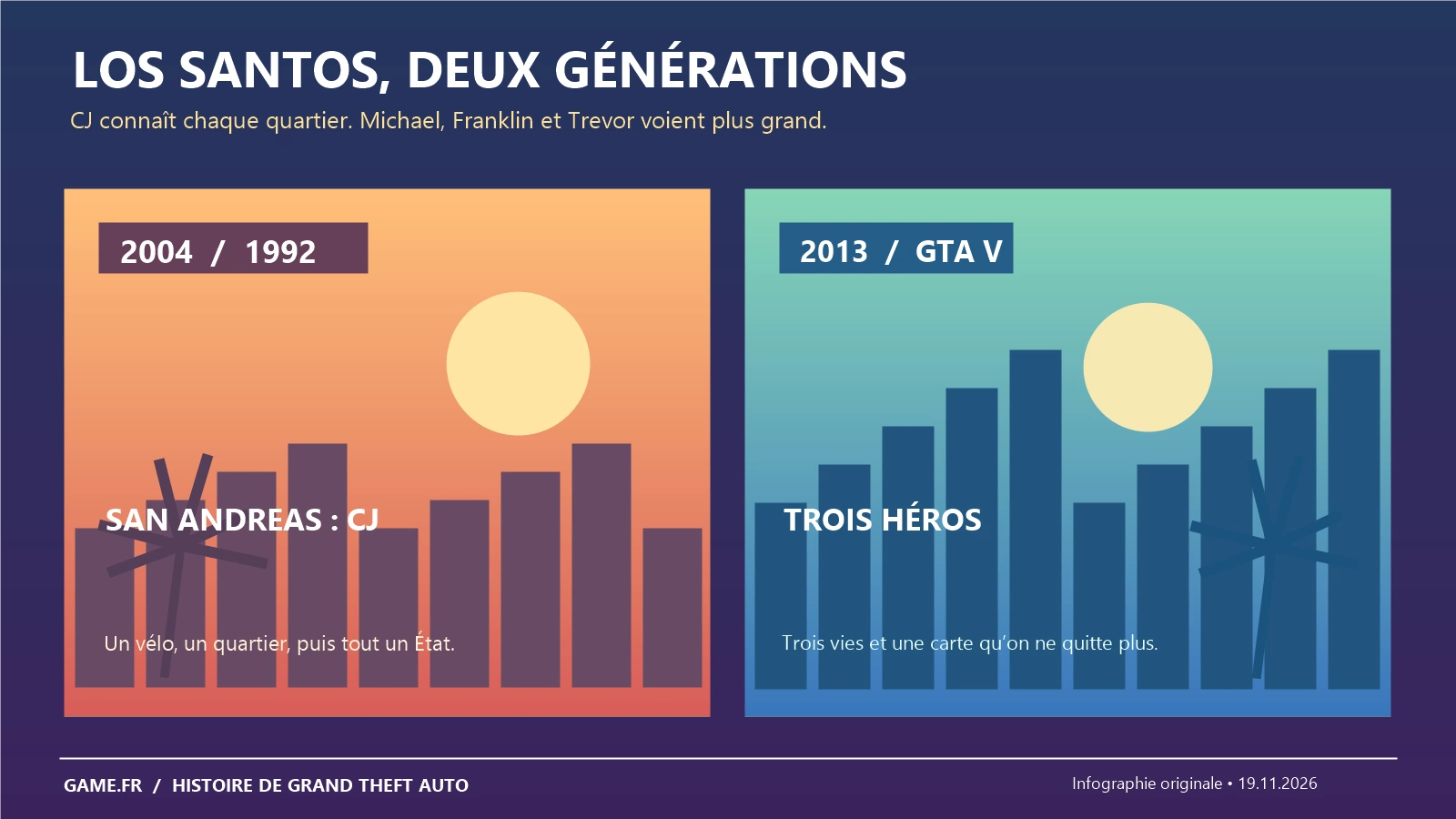
In 2013, GTA V makes character switching a storytelling mechanic. Michael, Franklin, and Trevor are not just there to diversify missions. They carry three ways to read Los Santos: tired wealth, social ambition, and uncontrolled violence. Switching from one to another gives the feeling that the city continues to exist outside our field of vision. The heists bring these trajectories together and turn the preparation, execution, and consequences into playable spectacle.
Los Santos opens onto Blaine County, its roads, desert, and mountains. Geography becomes a driver of surprise again. After GTA IV's concentration, we rediscover the taste for wandering aimlessly and ending up far from the city. Vehicles and changes of scenery serve this amplitude. The title remembers in its own way San Andreas, while posing another question: how to tell the story of an entire society with three characters who do not occupy it in the same way?
The comparison between Los Santos 2004 and Los Santos 2013 is revealing. In San Andreas, the city is the emotional starting point for CJ and one of the stages of a long journey. In GTA V, it is the centerpiece of a world staging celebrity, real estate, media, and consumption. This is not a simple graphical update: Rockstar reuses a familiar name to change the era, perspectives, and obsessions.
GTA Online: the open world's second life
Launched in the wake of GTA V, GTA Online transforms the lifespan of Los Santos. Players return to find friends, buy properties, collect vehicles, set up activities, prepare heists, or discover additions published over the years. We must distinguish the 2013 solo adventure from this constantly evolving service: the three heroes have a written story, while the online world has developed through successive updates. For those still roaming Los Santos, our GTA Online 2026 guide extends this return to the city.
Why has GTA V lasted so long? — Game.fr analysis. Its solo mode has its own strength, but GTA Online has made Los Santos a meeting place. The city is no longer just a backdrop to complete; it becomes a space where you come back because other players and new content change the evening.
This longevity sheds light on the thirteen years separating the initial releases of GTA V and GTA VI. However, it says nothing on its own about GTA VI's online features. Rockstar has not detailed here an equivalent whose systems we could honestly compare. For now, the story of GTA Online is that of GTA V, not a promise to project onto its successor.
GTA VI: announcements and first observations
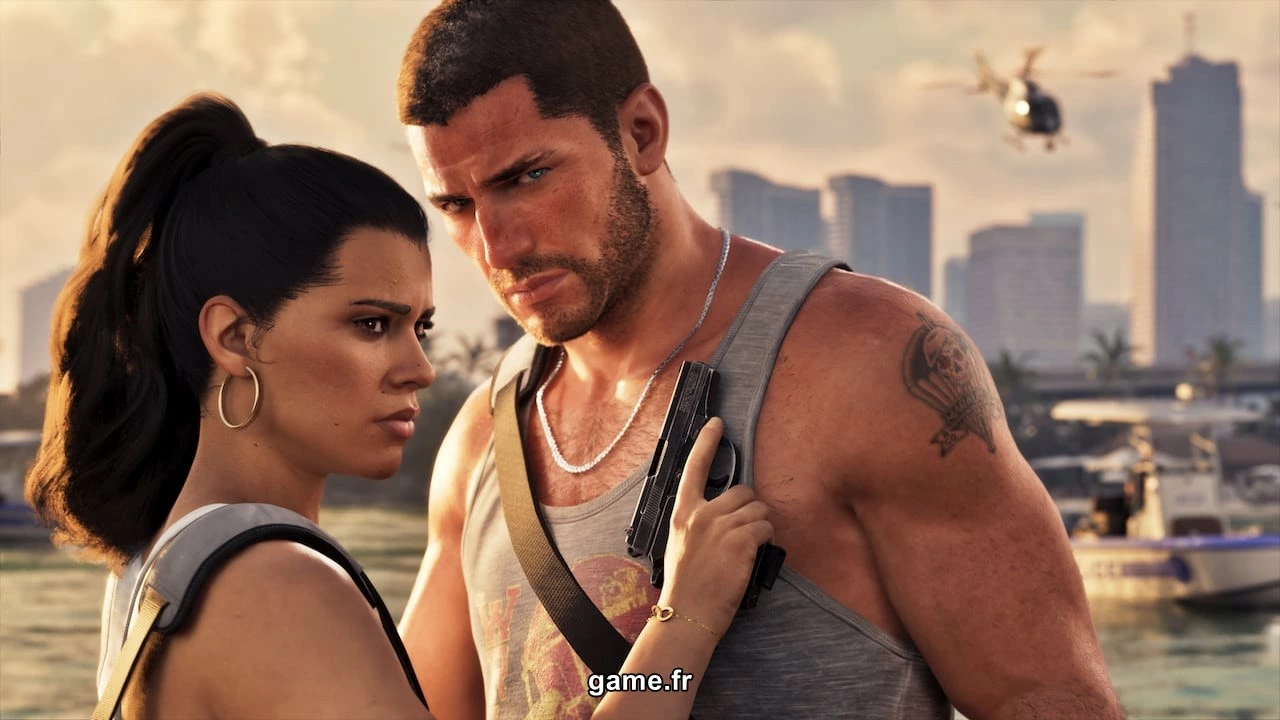
Confirmed by Rockstar. The launch of GTA VI is set for November 19, 2026, at midnight local time on PlayStation 5 and Xbox Series X|S. The game takes place in the fictional state of Leonida, with Vice City in the foreground. The publisher presents Jason Duval and Lucia Caminos as the two characters at the center of a criminal story that spans this state. Official unlock time ; presentation of Jason, Lucia, and Leonida.
Observed by the press. GTA V offered three perspectives on a fictional California; GTA VI makes Jason and Lucia a couple at the center of a fictional Florida. VGC describes the switch between the two during missions and considers their relationship decisive for the story. The Guardian highlights, on its side, the attachment this duo generates throughout the playthrough. These readings converge on the new importance given to the relationship.
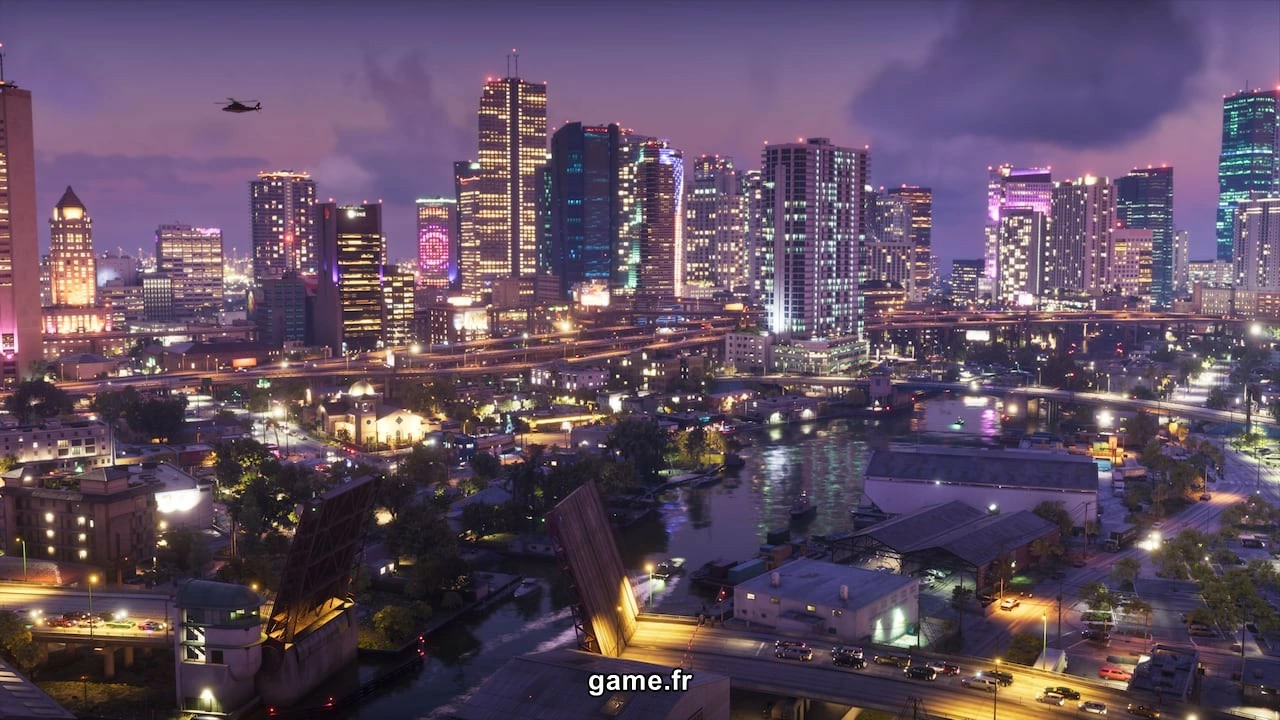
Confirmed by Rockstar, then described by the press. Leonida is not limited to Vice City: the publisher presents several places beyond its neon lights. VGC describes a territory mixing city, countryside, and small towns; Ars Technica emphasizes the changes in atmosphere during trips. We do not include any undocumented area size or number of interiors. For locations presented before release, see our dossier on GTA VI's open world, distinguishing its hypotheses from gameplay observations published since.
Observed by the press. The density of detail, animation, and variety of landscapes no longer rely solely on trailers: VGC describes them after a PS5 trial, while noting occasional drops in fluidity in dense areas. Ars Technica appreciates the trips and activities but is more reserved about certain missions and part of the satire. These opinions provide comparison points with GTA V.
Game.fr analysis. The duo, the state of Leonida, and the first critics' observations suggest a GTA that seeks to bring the intimacy of two characters closer to the scale of a territory. The precise systems of police, reputation, or online life must be attributed to identified trials before being generalized.
For the characters and practical information about the game itself, open our complete GTA 6 dossier. For consoles, our page dedicated to the release of GTA VI is the right entry point. Here, the question is that of legacy: what becomes of GTA's former freedom when a world and a duo take this importance?
GTA V vs GTA VI and the two Vice Cities
GTA V vs GTA VI: thirteen years between initial releases
| Element | GTA V | GTA VI, launching November 19, 2026 |
|---|---|---|
| Initial release | 2013 | November 19, 2026 |
| Region | San Andreas | Leonida |
| Iconic city | Los Santos | Vice City |
| Featured heroes | Michael, Franklin, Trevor | Jason Duval, Lucia Caminos |
| Initial platforms | PS3, Xbox 360 | PS5, Xbox Series X|S |
| Hero structure | Three playable protagonists | Two playable characters, according to press reviews |
| Geographical atmosphere | Fictional American West Coast | Fictional Florida and Leonida regions |
| Online mode | GTA Online, developed over time | Online systems not compared here due to lack of verified details |
Thirteen years do not guarantee a revolution on every line of the table. GTA V excelled at juxtaposing lives, territories, and spectacles. Game.fr analysis: the first GTA VI reviews suggest an interesting shift towards the relationship between two characters and the contrasts of Leonida. VGC praises the freedom to switch between Jason and Lucia; Ars Technica reminds us that the vastness of the world does not prevent some missions from feeling repetitive.
Vice City 2002 vs Vice City 2026: twenty-four years and two eras
| GTA: Vice City (2002) | GTA VI (2026) | |
|---|---|---|
| Era depicted | 1986 | Contemporary present |
| Main character(s) | Tommy Vercetti | Jason and Lucia |
| Setting | Vice City | Vice City within Leonida |
| Starting technology | PS2 generation | PS5 and Xbox Series X|S |
| Tone that can be described | Criminal rise and 1980s pop imagination | Story of a criminal duo, whose relationship is praised by several critics |
| Sound signature | Radios closely linked to the decade | Radios and contemporary soundtrack described by the press |
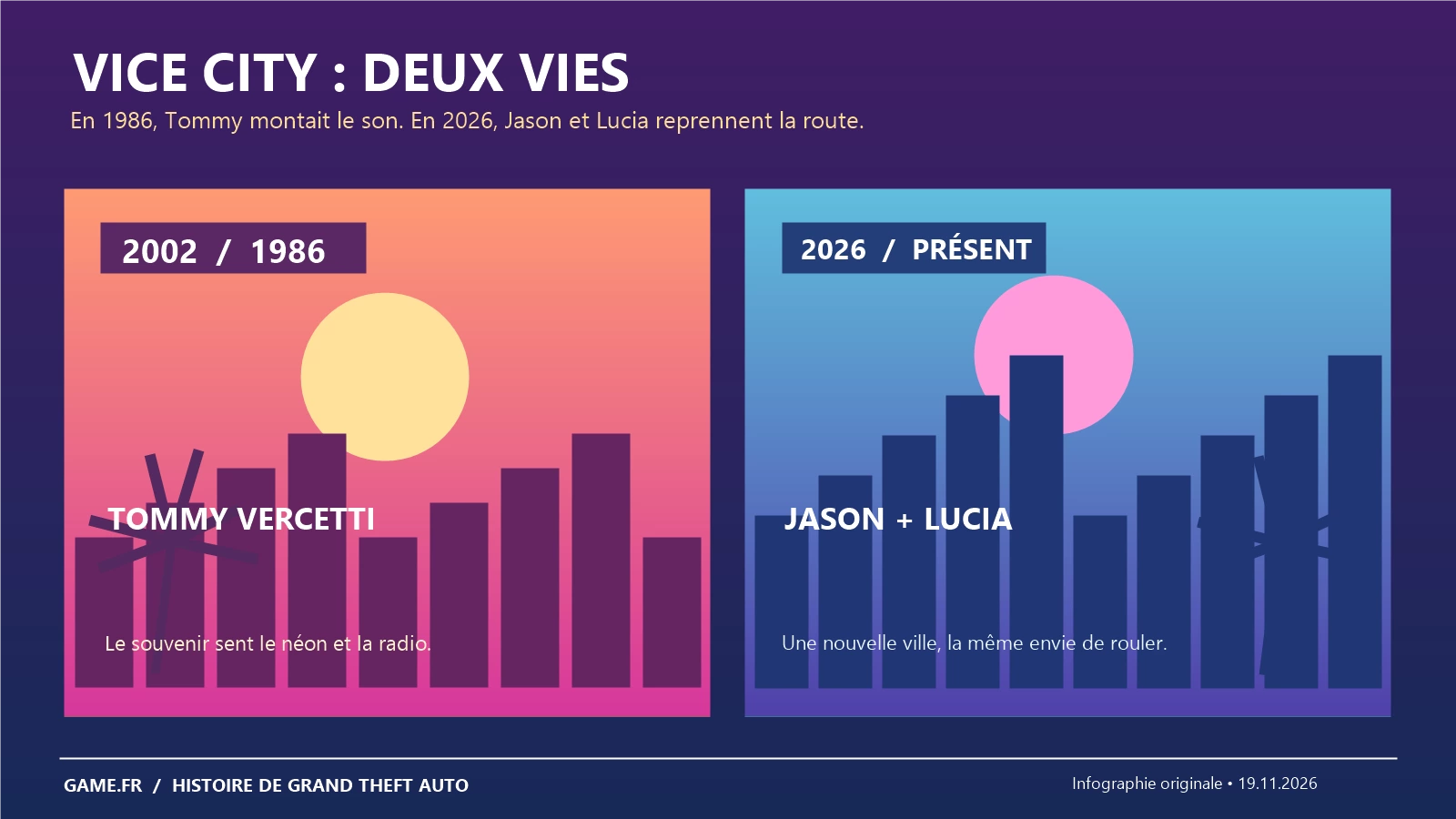
The first Vice City made us dream of a decade many players had not lived through. We experienced a fantasy of neon lights, beaches, and suits, with Tommy behind the wheel. GTA VI takes the same imaginary streets into the present, in a culture of images and media circulation that is different. Nostalgia thus works on two levels: recognizing a place and realizing it can no longer tell the same era.
This return offers an exceptional ground for comparison. VGC considers the contemporary Vice City striking despite its differences with the PS2 era; The Guardian emphasizes how Jason and Lucia give a human dimension to the urban spectacle. Fidelity to 2002 would be too narrow a criterion: the first Vice City succeeded precisely because it spoke of its own time.
Maps, characters, police, vehicles, and music
Maps: from schematic city to lived territory
1997 → 2001 → 2004 → 2008 → 2013 → 2026: this line tells several ways of drawing space, not a competition of square kilometers. GTA 1 lays out three cities flat; GTA III makes Liberty City three-dimensional; San Andreas connects cities and landscapes; GTA IV tightens its world to densify urban life; GTA V unites Los Santos with Blaine County; GTA VI officially places Vice City within Leonida.
The most interesting progression concerns the reasons to travel. In GTA III, turning a street corner reveals the power of 3D. In San Andreas, leaving Los Santos feels like changing worlds. In GTA IV, the journey reinforces Liberty City's compact identity. In GTA V, a road to the desert becomes a tonal pause. Regarding GTA VI, Ars Technica describes a crossing where neighborhoods, swamps, and islands change the atmosphere of the journey. Rockstar has not published any official area figures to report here.
Characters: from anonymous driver to duo
The first GTA mostly leaves room for the player. Claude, in GTA III, remains silent while Liberty City and its inhabitants speak around him. Tommy imposes a voice. CJ brings a family and a neighborhood. Niko carries a past he struggles to leave behind. Michael, Franklin, and Trevor make the plurality of perspectives the engine of GTA V. Jason and Lucia, as Rockstar presents them, move forward together in a matter beyond them. Official portraits of GTA VI.
Game.fr analysis: throughout the saga, the criminal is no longer just the tool that opens the map. He becomes the reason to cross it. This evolution does not remove player freedom; it creates a fertile tension between their desire to roam and the urgency of the narrative. One can love Claude's simplicity and Niko's density for perfectly different reasons.
The police: the rhythm of the chase
Since 1997, pursuers have given chaos its pace. GTA 1 and GTA 2 display police heads to represent the wanted level. With GTA III, the stars become the familiar symbol of the series, while the chase takes on a physical dimension in the 3D streets. Subsequent episodes modify patrols, roadblocks, helicopters, visibility, and escape possibilities according to their own rules. The fun often comes from a tiny decision: going under a bridge, changing vehicles, waiting, or risking one last acceleration.
In GTA VI, according to VGC, the police still pursue Jason and Lucia using a star-based wanted level. The journalist recounts a chase after a five-star pursuit, ending by hiding in a rail yard. This sequence is not enough to establish universal rules for detection, witness memory, or escape. VGC review, November 18, 2026.
Vehicles: each generation has its own way of driving
A car in GTA 1 is first and foremost a practical silhouette to steal. In GTA III, you see it from behind and discover the pleasure of recognizing a model in traffic. Vice City uses cars and two-wheelers to set its era. San Andreas multiplies ways to travel: bikes, trains, planes, and boats make the state a testing ground. GTA IV adds weight to braking and collisions. GTA V balances spectacle, variety, and customization.
Official screenshots show the vehicles of GTA VI; Ars Technica describes, after testing, the pleasure of switching from sports cars to trucks, motorcycles, and off-road vehicles. This testimony does not establish the exact number of models nor a measure of their physics. The real memory in GTA remains how a vehicle makes you discover a city, complete a mission, or lose the police.
Gameplay: always free, never fixed
From a top-down view, GTA 1 already gave us the pleasure of diverting a mission to try another car or another street. GTA III makes this improvisation physical: getting out of the vehicle, running, hiding, returning to the wheel. San Andreas adds activities and skills that invite you to inhabit its world; GTA IV gives more weight to bodies and driving; GTA V allows switching protagonists at the heart of the story. According to early tests, GTA VI notably renews the possibilities offered by Jason and Lucia, without erasing the pleasure of simply going elsewhere. VGC describes character switching during missions.
Cheat codes also tell the player side of the saga: interrupting the storyline to try something absurd is part of GTA's memory. For the new episode, our GTA 6 cheat codes guide on PS5 and Xbox gathers the commands reported by early guides and specifies those that Game.fr has not yet directly verified.
Graphics and technology: what pixels don't say
The visual comparison is spectacular: 2D in 1997, 3D city in 2001, major PS2 exploitation in 2004, high definition and more pronounced physics in 2008, vast detailed world on PS3 and Xbox 360 in 2013, then GTA VI designed for PS5 and Xbox Series X|S. Yet, a simple "resolution" line would miss the essential.
Technology also changes the staging of possibilities. GTA III's camera gives scale to the streets. GTA IV's animations modify the relationship to the body and accidents. GTA V makes credible the quick switch from one protagonist to another and the coexistence of a city, desert, and mountains. For GTA VI, early tests go beyond screenshots: VGC praises the world's detail but notes occasional slowdowns on the tested PS5. We keep these attributed observations without generalizing them to all consoles or situations.
Radios: GTA's sound memory
GTA is a series you listen to as much as you explore. From the first episodes, music accompanies the journeys. GTA III anchors the station principle in the 3D city. Vice City turns its radios into a time machine back to the 1980s. San Andreas changes color depending on the neighborhood, road, and chosen station. GTA IV and GTA V continue this work: the music selection, hosts, and ads give each urban fiction its own buzz.
For GTA VI, Rockstar announced Grand Theft Auto VI: The Album. VGC highlights after its test the scale of the radios and soundtrack. Our article on GTA 6 radios and music goes into detail. Perhaps the most beautiful comparison between the two Vice City games is: what era does each make us hear when we randomly turn the dial?
Is GTA really becoming more realistic?
The franchise's history does not follow a straight line from "simple" game to perfect simulation. San Andreas loves accumulation, fantasy, and almost absurd detours. GTA IV favors heavier driving, a compact city, and a disenchanted story. GTA V regains the energy of the grand spectacle, then GTA Online extends it into a lasting social space. Each change reshapes the balance between freedom, satire, credibility, and immediate pleasure.
Game.fr Analysis: the interesting question is not "Is GTA VI the most realistic?", but "What kind of realism makes its freedom more fun or more expressive?" A more convincing crowd can enrich exploration; it is not enough if it creates nothing to experience. A heavier car can make a chase thrilling; it can also slow down part of the audience. GTA IV showed this: technical progress can be a tonal choice, and this choice does not please everyone.
Satire evolves in the same way. The radios of Vice City mock a fantasized era, GTA V caricatures the obsession with media and image, and GTA VI takes place in a contemporary environment. Early reviews do not all interpret it the same way: VGC appreciates its podcasts and their perspective on 2026, while Ars Technica finds some of the satire less sharp. This divergence is more instructive than a verdict stamped on the game at release.
Secondary episodes not to forget
The timeline in the main table chooses eight milestones to keep track of the evolution. It does not summarize the entire GTA family. The expansions GTA London 1969 and London 1961 very early on move the formula outside American cities and into another historical moment. GTA Advance attempts to adapt the series to the Game Boy Advance and returns to an aerial perspective. Liberty City Stories and Vice City Stories exploit the two PS2-era cities on portable with new stories. Chinatown Wars rethinks perspective and controls again for a portable game.
Let's add the two narrative expansions of GTA IV, The Lost and Damned and The Ballad of Gay Tony, collected in Episodes from Liberty City. Their protagonists Johnny and Luis give Liberty City other voices before GTA V's trio. Rockstar details the collection.
These episodes remind us of one thing: the history of GTA is not read only on the axis "bigger, more beautiful." It includes adaptations to different machines, returns to familiar places, and format experiments. Ignoring them would make one believe the series only advanced at the pace of its major console launches.
Which episode transformed GTA the most?
| Category | Our choice | Why |
|---|---|---|
| Technological breakthrough | GTA III | The 3D city immediately changes the way of moving and exploring. |
| Freedom and variety | San Andreas | Its territory, vehicles, and activities open up a multitude of detours. |
| Realistic turn | GTA IV | Physics, driving, and narrative impose a different weight on actions. |
| Longevity | GTA V and GTA Online | Los Santos becomes a place of collective return for over a decade. |
| New point of comparison | GTA VI | Leonida and Jason–Lucia renew the historical comparison. |
Game.fr editorial analysis: if we had to pick only one, it would be GTA III. It transformed the promise of GTA 1 into a form of open world that can still be recognized today. But the choice depends on the memory each person seeks: CJ's journey, Tommy's neon lights, Niko's melancholy, or evenings with friends on GTA Online may matter more in a player's life. Which GTA do you think revolutionized the series the most?
FAQ: the evolution of GTA
What is the first GTA?
The first Grand Theft Auto was released in 1997. It is played from a top-down view and already offers stolen cars, missions, police, and free traffic in stylized versions of Liberty City, San Andreas, and Vice City.
How many main GTAs are there?
This dossier follows eight major milestones, from GTA 1 to GTA VI, including Vice City and San Andreas among the major entries in the series. This does not count all the games bearing the GTA name: expansions, portable episodes, and Stories are also part of this history.
Which GTA brought the series into 3D?
GTA III, in 2001, established the main formula in a three-dimensional Liberty City that you explore on foot and by car. It did not invent the open world, but it strongly influenced its evolution.
Which GTA features three playable characters?
GTA V stars Michael, Franklin, and Trevor. Switching between them offers multiple perspectives on Los Santos and notably structures the heists.
What is the difference between Vice City 2002 and GTA VI?
GTA: Vice City is set in 1986 and follows Tommy Vercetti's rise. GTA VI returns to a contemporary Vice City, integrated into the state of Leonida, featuring Jason and Lucia. Early press reviews describe a more detailed city and a relationship at the heart of the story.
When was GTA VI released? On which consoles?
Rockstar sets the launch for November 19, 2026, at midnight local time on PlayStation 5 and Xbox Series X|S. Its packaging shows the official time and the Associated Press confirms active players in New Zealand. Availability on each account and console remains to be locally verified.
Who are the central characters of GTA VI?
Jason Duval and Lucia Caminos are the two characters presented as the story's focus by Rockstar. Their relationship and the consequences of a failed criminal operation form the announced starting point. Official portraits.
How many years separate GTA V and GTA VI?
Thirteen years separate the initial releases of GTA V in 2013 and GTA VI in 2026. This period does not mean there was no GTA for thirteen years: GTA Online continued to evolve in between.
Which GTA revolutionized the series the most?
According to Game.fr analysis, GTA III remains the most convincing choice for the decisive leap to 3D. San Andreas expanded scale and customization, GTA IV changed the physical and narrative feel, while GTA V and GTA Online transformed the franchise's longevity.
Conclusion: the same unexpected detour since 1997
It is easy to measure twenty-nine years of GTA in pixels, characters, and kilometers traveled. It is harder to measure the moment when you decide to turn left while the mission points right. GTA 1 already allowed this little disobedience. GTA III gave it 3D streets; Vice City, a song; San Andreas, a horizon; GTA IV, weight; GTA V, three lives and a city you revisit with friends.
GTA VI now takes us to Leonida with Jason and Lucia. Early reviews suggest their relationship and this setting will mark the series' history. But the question that has brought us back to GTA since 1997 remains unchanged: what happens if you take this car and just go see somewhere else?
Historical and critical sources
- Rockstar Games: GTA III, III / Vice City / San Andreas trilogy, Episodes from Liberty City and GTA VI : official games, characters, and setting.
- Grand Theft Wiki: GTA 2 research level and GTA Wiki: first Grand Theft Auto : police head icons in the first two titles.
- Take-Two: history of DMA Design, NaturalMotion: Euphoria animation in GTA IV and Rockstar: Vice City in 1986, San Andreas in 1992.
- Rockstar: official schedule for GTA VI and Associated Press: first sessions in New Zealand.
- Rockstar: platforms for the remastered trilogy, GTA V and GTA VI; Nintendo: Switch 2 compatibility; Xbox: GTA IV.
- VGC, review dated November 18, 2026, The Guardian, review dated November 18, 2026 and Ars Technica, review dated November 18, 2026: observations attributed on GTA VI, pages accessed November 19, 2026.