Shinji Mikami and the balance between horror and science fiction in video games.
Imagine a young Japanese developer, freshly hired by Capcom in 1990, starting out on unassuming Disney games. No one suspected that this man, Shinji Mikami, would literally reinvent fear in video games. In 1996, he released Resident Evil, a game that placed players in a gloomy mansion with limited ammunition, unpredictable monsters and an atmosphere of absolute terror. Survival horror was born.
A success that exceeded every expectation: in 2026, the
Resident Evil franchise has sold more than
183 million units worldwide,
making the series one of the biggest franchises in video game
history — and Shinji Mikami is its original architect.
But what truly sets Mikami apart from other horror game creators is his obsession with a very precise combination: visceral horror on one side, and the darkest science fiction on the other. His games do more than scare us. They ask a fundamental question: how far can science betray us before destroying us?
The genre now known as science-fiction horror — or science-fiction action — has continued to evolve under his direction. To understand why his works have stood the test of time, we need to examine their foundations: storytelling, pacing, technological stakes and, above all, the moral depth hidden behind every explosion, mutation and final boss.
The Foundations of Science-Fiction Horror: From Invasion to Narrative Engine
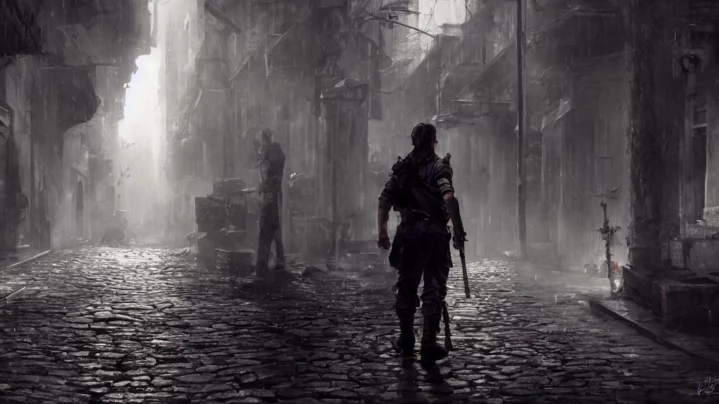
Narrative pacing and tension in Shinji Mikami's science fiction.
When Resident Evil launched in 1996, players discovered something unprecedented: science as a source of terror. The Umbrella Corporation is not an evil empire that appeared out of nowhere — it reflects a reality we were only beginning to imagine. Secret laboratories, a virus created by overly ambitious men, monsters that had still been human only yesterday. Mikami makes bioengineering the true monster of the story, long before the zombies.
With Dino Crisis in 1999, he pushed the concept even further. The dinosaurs are not there by magic — they arrive through a time-teleportation experiment gone wrong. Science has opened a door it can no longer close, and the player must pay the price. This narrative engine — technology as the driver of catastrophe — would become Mikami's signature.
Early games in the genre, like science-fiction films from the 1950s, used technology as a simple backdrop for danger. Mikami does exactly the opposite: for him, technology is the threat. Whether the hero is a soldier, scientist or survivor, they must do more than run away. They must understand the rules of a world broken by science if they hope to survive. This need for understanding is what separates a simple horror sequence from a genuine work of science fiction.
The balance is delicate, however. If action is too omnipresent, character development suffers. If the science fiction becomes too theoretical, the player loses interest. Mikami has always known how to maintain this controlled tension, using high-tech stakes to amplify human drama. In the best moments of Resident Evil 2, for example, the biological threat is never abstract — it looks you in the eyes through the mutation of someone who was still human just a few hours earlier.
Narrative Pacing: Managing Tension in Science-Fiction Action
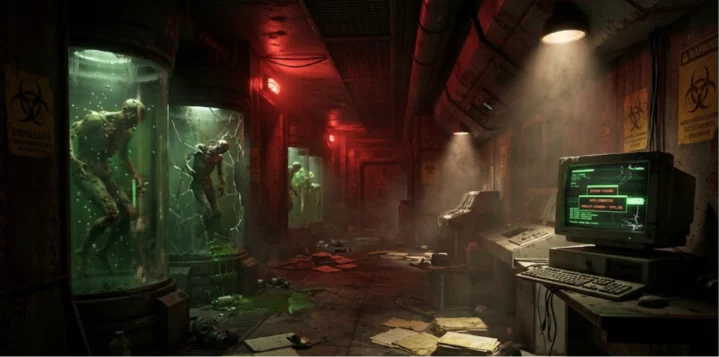
A technological gadget becoming philosophy in Shinji Mikami's games.
There is a moment in Resident Evil 7 — a game produced in the direct lineage of Mikami's vision — when the player realizes there is no immediate way out. No weapon, no ammunition, just them and the darkness. This is precisely the kind of moment Mikami has always sought to create: the calm before the storm, that period of pure anxiety when silence becomes as threatening as any monster.
A good game in this genre, like a good work of science-fiction action, uses pacing as a sophisticated tool for emotional manipulation. Mikami understood very early that alternating intense pressure with forced breathing room was the key. First, the rules of the world and the technology's flaws are established. Then, a series of escalating events increases the level of threat exponentially. Finally, the climax must offer catharsis — an emotional release — in which the hero wins not only the physical battle, but also their own understanding of the situation.
This management of time is crucial. In Resident Evil 4, Mikami once again revolutionized the genre by introducing an over-the-shoulder camera that changed everything. The action became more dynamic and readable, but the foundations of horror remained intact: every fight reveals something about the hero's limitations, and every enemy is a metaphor for the technological or biological threat structuring the story.
After an intense assault, the viewer — or player — needs time to breathe and process the stakes. This is what Mikami calls “anchoring the threat in a concrete reality, even a futuristic one.” This principle has become an unwritten rule of the genre, since adopted by dozens of creators in video games and film alike.
The Impact of Technology: When a Gadget Becomes Philosophy
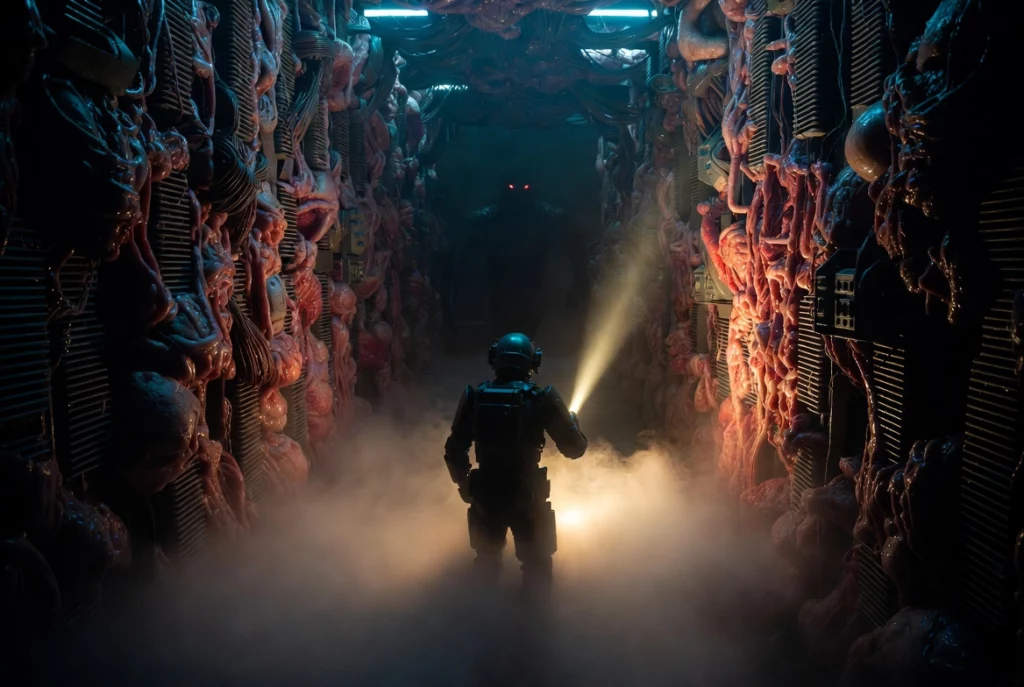
The evolution of complex moral questions in Mikami's science-fiction horror.
In 2010, Mikami released Vanquish at PlatinumGames. On paper, it is a fast-paced, ultra-quick futuristic shooter, worlds away from the grim atmosphere of Resident Evil. But look closer: the story revolves around a space weapon capable of destroying an entire city, a corrupt government and an artificial intelligence that has taken control. Once again, technology has turned against humanity.
For Mikami, technology is never just a gadget or a neutral combat tool. It is an extension of the conflict, a mirror of human flaws. Is the weapon too powerful, making the conflict trivial? Or is the technology misunderstood, forcing the hero to improvise with it or repair it under pressure?
The most accomplished stories in his work explore the unintended consequences of innovation. In The Evil Within, artificial intelligence, nanobots and mind manipulation are no longer simple abstract threats — they are extensions of human ambition, reflecting our desire for control and our fear of obsolescence. The question is no longer whether technology will save us, but at what cost we will allow it to save us.
This philosophical dimension is what elevates Mikami's science-fiction horror beyond simple entertainment. The conflict becomes an ethical struggle as much as a fight with a laser rifle. And this is precisely what productions in the Umbrella universe have not always managed to maintain when they moved away from his original vision.
The Evolution Toward Complex Moral Questions: Beyond Good and Evil
In The Evil Within, released in 2014 and designed as Mikami's return to his roots after years at PlatinumGames, protagonist Sebastian Castellanos is not a conventional hero. He is broken and traumatized, and the horrors he faces are as much manifestations of his psyche as they are genuine threats. Mikami takes a decisive step here: the enemy is no longer merely the monster in front of you, but also what you carry inside.
The most memorable science-fiction horror works no longer simply point to a “villain.” They explore the gray area, that uncomfortable moral territory where the protagonist is forced to make impossible choices. Winning may mean sacrificing a fundamental principle, or worse, becoming the very threat you are fighting. This is exactly the path taken by many of Mikami's characters.
This moral dilemma forces the player — and the viewer — to question the very nature of humanity. Should a minority be sacrificed to save humanity? Can a corrupt scientific institution be trusted to protect us? These questions, which Mikami has raised since 1996, resonate more strongly than ever today in the age of artificial intelligence and biotechnology. This thematic depth keeps the work compelling long after the explosions have faded.
FAQ: Shinji Mikami, Horror and Sci-Fi
Did Shinji Mikami invent survival horror?
He is considered the “father of survival horror” thanks to Resident Evil (1996), which defined the genre's conventions: limited resources, confined spaces, constant tension and science-fiction storytelling.
What are Shinji Mikami's key games?
Resident Evil (1996), Dino Crisis (1999), Resident Evil 4 (2005), God Hand (2006), Vanquish (2010), The Evil Within (2014) and, as a producer, Ghostwire: Tokyo and Hi-Fi Rush.
Why do horror and sci-fi work so well together for Mikami?
Because science fiction allows him to make fear feel credible and universal: his monsters do not come from the supernatural, but from humanity's own mistakes. Technology becomes the source of every anxiety.
What is the main message in Mikami's work?
That the real threat is never the monster, but what humanity is capable of creating, letting loose and no longer controlling.
Conclusion: Science-Fiction Horror as a Mirror of Humanity
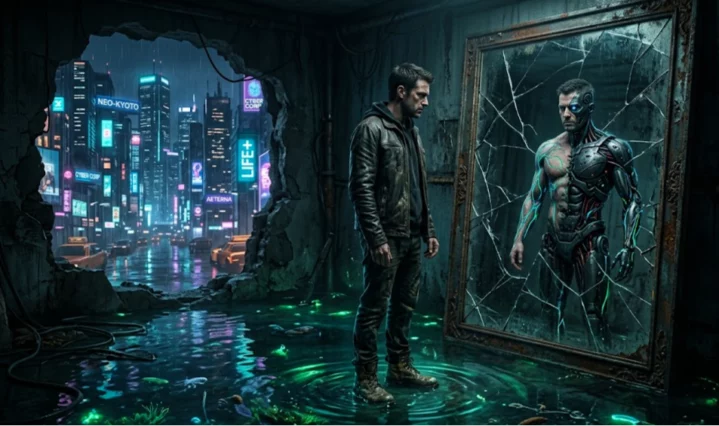
Shinji Mikami's science-fiction horror as a mirror of humanity.
What makes Shinji Mikami's work so enduring is that it always speaks to us about ourselves. Through his infested mansions, collapsing laboratories and devastated cities, he holds up a mirror. His games tell us that true horrors are not born in the darkness, but in the white rooms of laboratories, in the excessive ambitions of powerful men and in our inability to anticipate the consequences of our own genius.
The science-fiction horror genre, as he shaped it, is a feast for the nerves as well as a workout for the mind. It uses the spectacle of action and terror to conceal a deep reflection on ethics, progress and the human condition. Mastering this narrative alchemy has been Mikami's constant challenge — and his greatest achievement.
Today, as artificial intelligence and bioengineering are no longer science fiction but part of everyday life, his games resonate in a way he may not have fully anticipated. The real question is no longer “could this happen?” — but rather “is it already happening?”