007 First Light plunges you into the world of James Bond, but from an unusual perspective: that of a rookie Bond, still in training, more vulnerable and more human. Between stealth, action, gadgets and improvisation, this guide will help you get off to a strong start without missing anything important.
Understanding 007 First Light before playing
Key takeaways
- A Bond in training, more vulnerable and more human.
- A blend of stealth, action and gadgets.
- An espionage game that demands observation, anticipation and improvisation.
A Bond in training
In 007 First Light, you play as a Bond who has not learned everything yet. This choice changes everything: the character is less invincible, more nervous and more believable as he grows in power. That is precisely what makes the experience interesting: you are not playing a fixed myth, but an agent in the making.
A blend of stealth, action and gadgets

The heart of the game lies in balancing discretion and confrontation. You must know when to stay in the shadows, when to manipulate the environment and when to switch to a more offensive approach. Gadgets play a central role here, opening up several solutions to the same situation.
A true espionage game
Unlike a simple third-person shooter, 007 First Light emphasizes reading the terrain, useful dialogue, reconnaissance and choosing the right moment to act. The game rewards preparation more than reflex shooting. This approach sets it apart and is worth understanding before starting your first mission.
Setting up your game to avoid regrets
Before heading out on a mission, take a few minutes to adjust your gameplay comfort settings. A good initial setup will help you avoid bad habits and make the experience smoother.
Key takeaways
- Choose a difficulty suited to your pace.
- Reduce the interface if you want greater immersion.
- Keep aiming and tagging assists enabled or disabled according to your skill level.
Choose the difficulty suited to your play style
If you are discovering the game, it is best to start on a comfortable difficulty. This gives you time to learn the systems, understand open areas and test gadgets without being punished too quickly. More experienced players can then raise the difficulty to seek a genuine challenge.
Manage the interface for maximum immersion
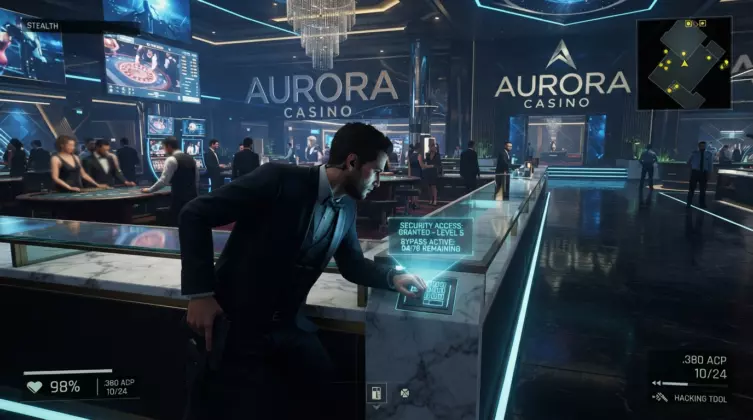
An overloaded HUD can quickly break the espionage atmosphere. Reduce unnecessary elements if you want to focus on reading locations, monitoring enemies and the tension of each mission. The idea is not to hide everything, but to keep what genuinely helps you make decisions.
Enable or disable aiming and tagging assists
Assists can make learning easier, especially at the beginning. However, if you want a more demanding and polished experience, limiting them may be worthwhile. The key is finding the right balance between comfort and precision.
Game.fr tip: test your settings during the first missions, then adjust them after one or two sequences so you do not get stuck with a poor configuration.
Key mechanics to master from the prologue
The prologue sets the tone for the game: observation, stealth, timing and smart use of your tools. If you understand these basics early, the entire progression becomes easier.
Key takeaways
- Master stealth and cover.
- Use Q's gadgets at the right moment.
- Know when to fight and when to run.
Master stealth, cover and lines of sight
Cover is not just shelter: it is a tool for reading the situation. By monitoring vision cones, enemy movements and entry points, you multiply your options. In a game like this, patience always pays off more than haste.
Use Q's gadgets wisely
Gadgets are not just there for show. They let you distract, bypass, neutralize or open a route without forcing a fight. The right instinct is to treat each tool as a mission solution, not merely as a bonus.
Know when to fight or flee
Not every situation deserves a head-on confrontation. Sometimes falling back, observing and returning from another angle is the best decision. That is also what thinking like a spy means: winning without exposing yourself unnecessarily.
Missing nothing from the missions and your Bond
Good progression does not depend solely on the main mission. Exploration, challenges and build choices also make a difference.
Key takeaways
- Explore semi-open areas methodically.
- Replay chapters to test different approaches.
- Build a Bond that matches your play style.
- Invest your skills and upgrades wisely.
Take the time to explore semi-open areas
Semi-open areas often hide progression opportunities, useful items and alternative routes. Taking the time to observe before moving forward maximizes your chances of missing nothing. It is also the best way to spot discreet paths and less obvious solutions.
Understand chapter and challenge replayability
Replayability adds real value to the game, letting you revisit a mission with a different approach. You can test a cleaner infiltration, a more aggressive route or a more tactical reading of the level. This naturally extends the game's lifespan.
Build your James Bond according to your style
You can steer your progression toward a stealthy, combat-focused or hybrid approach. The important thing is to remain consistent, since scattered choices often result in a less coherent and less effective character. A well-built Bond should reflect how you like to solve situations.
Manage skills and upgrades to avoid regrets
Avoid spending your points at random. First focus on skills that strengthen your main approach, then supplement them with more situational bonuses. A good build serves your way of playing; it is not a collection of talents chosen without a plan.
Classic mistakes to avoid at all costs
Mistakes during the first few hours are often the same. Avoiding them will save you time and a great deal of frustration.
Key takeaways
- Do not shoot everything at the first alert.
- Do not underestimate gadgets.
- Do not move forward without observing the area.
- Do not overlook MI6 briefings.
Trying to shoot everything at the first alert
Reacting too quickly often turns a stealth mission into a desperate firefight. It is better to slow down, understand the situation and choose the right angle of attack. This is often where the game reveals its true logic.
Ignoring gadgets in favor of weapons
Weapons solve one problem, but gadgets often solve several. They save time, energy and ammunition while preserving the game's espionage identity. Ignoring them means missing out on an important part of the experience.
Neglecting to observe the area before acting
A few seconds of observation are often enough to spot a better entrance, an isolated guard or an interactive object. This simple habit prevents many mistakes. In 007 First Light, reading the terrain is a core part of the gameplay.
Ignoring MI6 briefings
Briefings establish the objective, prevent misunderstandings and help you prepare your approach. Ignoring them means playing blind. For an espionage game, that would be a shame.
Making inconsistent progression choices
A scattered build often creates a less effective Bond. Choose a clear direction, then reinforce it with complementary skills. This consistency makes progression more enjoyable and easier to understand.
007 First Light Missions: Walkthrough and progression
Here is an overview of the campaign's main missions. Each mission calls for a different approach, ranging from pure stealth to frantic action.
Mission 1: Baptism of Fire
James Bond's first real mission. Stay in the shadows and use your laser watch to disable cameras without triggering the alarm.
Mission 2: High-Risk Infiltration
A complex nighttime mission. Your objective is to extract data from the central server. Prioritize silent takedowns and hide the bodies.
Understanding the HUD and gameplay
The 007 First Light interface (HUD) is streamlined to encourage immersion, but it is essential to read it correctly:
- Detection indicator (top center): It gradually fills when you are in an enemy's field of vision. Take cover before it turns red!
- Gadget icon (bottom left): This shows which Q gadget is currently equipped and its cooldown.
- Stamina bar: Very useful for tracking the limits of your sprints. Do not exhaust yourself while escaping.
Mastering this HUD will let you plan your actions like a true MI6 spy.
FAQ
- Which gadgets are the most useful in the game?
- The most useful gadgets are those that let you distract, bypass or neutralize enemies without alerting the entire area. Their value depends mainly on how you approach missions.
- How can I improve my skills quickly?
- Focus on missions, challenges and replay loops that provide the most useful experience. The goal is to strengthen your main approach before moving on to secondary bonuses.
- Is it better to play solo or as a team?
- 007 First Light is designed as an experience centered on Bond and his personal progression. The core experience is therefore a solo approach, giving you full control over the pace and mission choices.
Conclusion
By following these fundamentals, you will approach 007 First Light with the mindset of an agent in training rather than the reflexes of a simple action-game player. You will gain fluidity, immersion and efficiency during the most tense missions. The best instinct remains simple: observe, prepare, then act at the right moment.