What will tomorrow's MMORPGs look like? After decades dominated by quests, levels, raids and expansions, studios are now exploring more persistent worlds, economies shaped more strongly by players and characters capable of reacting in less predictable ways. Generative artificial intelligence is also opening up new possibilities, although many of these technologies remain experimental in 2026.
This look at the future MMORPG distinguishes features that have already been deployed from experimental avenues, including generative AI in MMORPGs and intelligent NPCs.
1. Truly persistent MMORPG worlds
To continue this comparison, also check out our feature on classic MMORPGs that are still worth playing in 2026.
The principle of an MMORPG is already to offer an always-available universe shared by a large number of players. But this persistence is often limited: cities return to their initial state, NPCs repeat the same behaviors and major events are mainly decided by developers. One possible evolution would be to create worlds whose systems genuinely continue to evolve even when the player is away. This could include:- territorial control by different factions;
- price variations linked to available resources;
- trade routes changed by players;
- cities whose services evolve according to their activity;
- conflicts with lasting consequences;
- dynamic events triggered by the state of the world.
Ashes of Creation and Pax Dei: two approaches to watch
Ashes of Creation illustrates an ambitious approach: its developers present a settlement system whose evolution depends on collective activity, as well as exchanges and conflicts between players. However, the Steam page describes an active alpha phase, with features still being balanced and possible resets. The announced vision of a dynamic world must therefore be distinguished from how it will operate at large scale over time. → See Ashes of Creation's design goals and development status Pax Dei explores another path: the social sandbox MMO, with construction visible to other players, crafting, trading and community life in a shared space. Its relevance to the genre's future lies less in AI-powered NPCs than in the stories produced by communities themselves. → Read the studio's presentation of Pax Dei's visionMethodological note: these games illustrate design choices, not proof that the "future MMORPG" already exists in a finished form.
2. Player-created economies: EVE Online already shows how far this can go
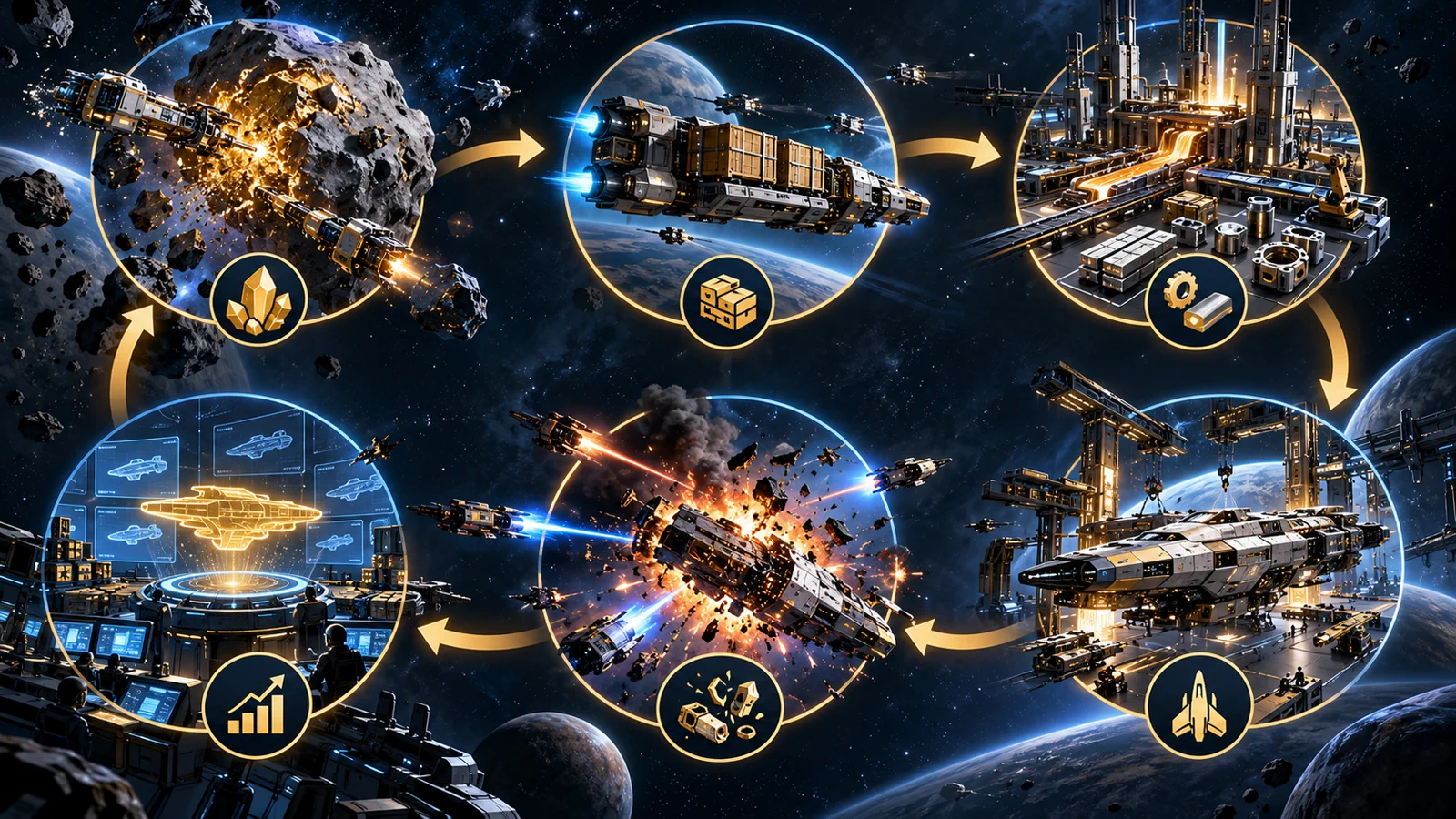
The idea of an economy strongly influenced by players is not new. EVE Online has long been one of the most advanced examples. CCP describes its economy as largely player-driven: a large share of the items bought and sold are manufactured by players themselves. → Discover how EVE Online works on the official website The system creates a genuine economic chain:- players gather resources;
- others transport them;
- industrialists manufacture components;
- these components become ships or equipment;
- combat destroys some of these goods;
- demand creates new production needs.
Would a completely free economy be desirable?
Not necessarily. Even an economy largely driven by players requires rules, sources of currency, resource sinks and developer intervention. The goal of future MMORPGs will probably be less about creating a completely autonomous economy than offering enough freedom for collective decisions to have real consequences.A living economy must remain welcoming
Rising prices or the dominance of a corporation can enrich a server's stories, but also discourage newcomers. Taxes, caps, starter protections, control over money creation and item-destruction systems are all possible levers. None guarantees a balanced system on its own: their effectiveness depends on players' actual behavior.The September 2026 economic report
The report published by CCP on October 14 confirms the value of following these markets over time: in September, mining value fell again, while production increased in low security space. Active ISK balance went from +82.2 trillion in August to −144.7 trillion in September, and mineral and module price indexes declined. These figures describe one specific month; they illustrate the circulation and destruction of in-game wealth without guaranteeing future price movements.
→ Read the official EVE Online economic report for September 2026
3. Generative AI could transform NPCs
Another much more recent development concerns generative artificial intelligence. In traditional MMORPGs, dialogue is generally written in advance. An NPC has a limited number of responses and follows a predefined script. AI models could theoretically create characters capable of responding more freely while taking into account:- their personality;
- the quest context;
- the location;
- previous events;
- the player's actions.
Voyage: an AI-powered persistent world, at a different scale from an MMORPG
On August 26, 2026, Latitude opened Voyage to the public on the Web, iOS and Android. This role-playing platform lets users create a character and explore persistent worlds alone or with friends, with AI narrating events based on players' choices. According to Latitude, its World Engine maintains a shared state — characters, locations, relationships, rules and consequences — so that AI improvisation alone does not decide what actually happened.
Voyage supports groups of up to eight people on its public multiplayer servers. It is a useful example of shared AI role-playing, but its format and scale do not make it a traditional MMORPG. Instead, it shows how world simulation can be separated from narrative generation.
→ See the official announcement of Voyage's public launch
Ubisoft NEO NPCs: a prototype, not yet a new standard
In 2024, Ubisoft presented NEO NPCs, an experiment conducted by Ubisoft Paris with NVIDIA and Inworld. The goal was to test more natural conversations between players and characters powered by generative AI. An important point: Ubisoft explained that storytellers remained responsible for the character's personality, story and style. AI then generated responses within that framework. → Discover NEO NPCs at UbisoftTeammates: Ubisoft continues its experiments
Ubisoft went a step further in 2025 with Teammates, presented as its first playable experience focused on generative AI. The project explores characters capable of understanding voice commands and reacting to the player in real time. Here too, this should be described as an R&D experiment, not technology already deployed across Ubisoft games.Ubisoft presented Teammates on November 21, 2025, as a playable research experience tested in a closed group of several hundred players. The demonstration explores voice commands and teammates that react to context; it remains an experimental project.
→ Read Ubisoft's official presentation of Teammates
For another example of AI changing the role of support characters, read our analysis of robots and artificial intelligence in Modern Warfare 4.
See Ubisoft's technology research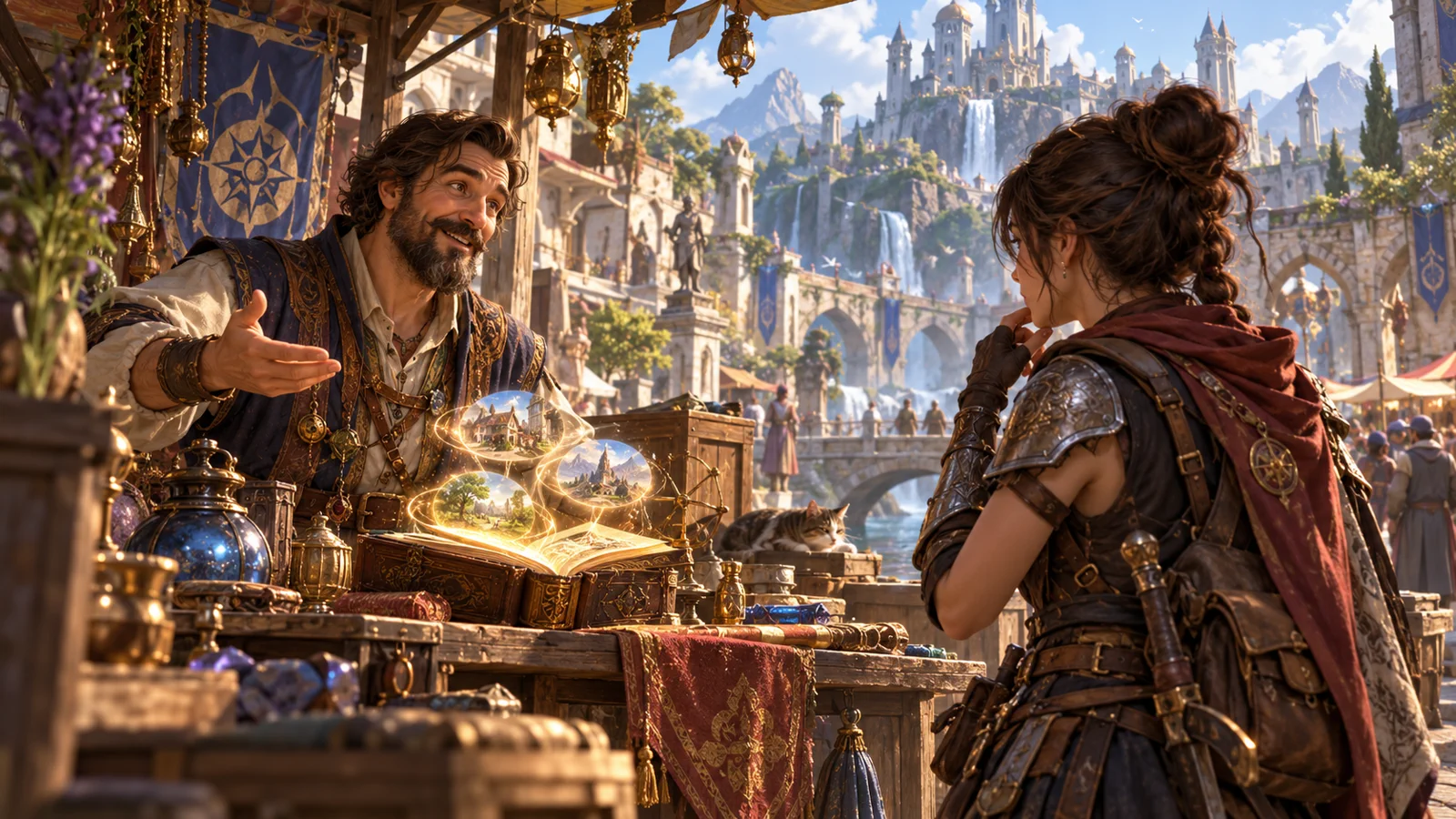
4. NVIDIA ACE: toward characters capable of talking and acting
NVIDIA is developing ACE for Games, a collection of technologies for developers who want to create conversational or more autonomous characters. ACE includes components dedicated to:- speech recognition;
- language models;
- speech synthesis;
- facial animation;
- decision-making;
- access to contextual information.
A concrete example outside the MMORPG genre is PUBG Ally, an AI-controlled teammate developed by KRAFTON with NVIDIA ACE. A temporary public beta was offered in PUBG: BATTLEGROUNDS from June 17 to 30, 2026. The character could understand voice or written commands, adapt to combat and loot situations, and act in the match. KRAFTON and NVIDIA describe a hybrid architecture: a behavior tree handles immediate reactions, while small locally run models process language and context. This limited beta illustrates a real integration, but does not mean MMORPGs have already adopted this kind of character at scale.
→ Read KRAFTON and NVIDIA's technical account of PUBG Ally
NVIDIA ACE: smaller local models in October 2026
On October 27, NVIDIA presented Nemotron 3.5 Bolt E4B 4GB, a small model designed for AI-powered characters and local operation. NVIDIA highlights multi-turn conversations, tool use, grounding in game data, a 64,000-token context and support for 35 languages. These features address several constraints discussed later in this article — latency, memory and consistency with game state — but they describe developer tools and demonstrations, not widespread adoption in MMORPGs.
The same publication cites SkyrimNET, a mod for The Elder Scrolls V: Skyrim that adds memory, voice and generative interactions to NPCs. NVIDIA also announced AI animal companions in Aniimo, expected in early 2027. These are examples adjacent to MMORPGs, not features of a massively multiplayer world. The distinction remains important: a convincing demonstration does not yet prove that a system can operate at scale on a shared server.
→ Read NVIDIA's October 27, 2026 ACE update
Why this could be particularly interesting in an MMORPG
A massively multiplayer world often contains hundreds or thousands of secondary characters. A sufficiently controlled AI could allow some NPCs to:- take recent events into account;
- adapt their responses;
- react to the player's reputation;
- offer several ways to resolve a situation;
- remember certain important interactions;
- act in the world instead of simply reciting dialogue.
5. Why generative AI will not simply replace writers
Using a language model in an MMORPG also creates many problems.Narrative control
A character must respect the universe, the game's rules and its personality. An NPC that invented information contradicting the story would quickly destroy immersion. This is precisely why Ubisoft's experiments use characters whose narrative foundations remain built by human authors.Computing costs
A demonstration with a few characters does not prove that an MMORPG can run thousands of NPCs for many players simultaneously. At this scale, developers must manage inference, speech synthesis, moderation, latency and server capacity.Who pays for NPC interactions?
This question remains prospective: no single business model has emerged for generative NPCs. One option is to run compact models on the player's computer or console, limiting cloud calls but imposing hardware requirements. Cloud processing simplifies model control and updates, at the cost of recurring servers, bandwidth and latency. A hybrid architecture could reserve generative models for important exchanges while using written dialogue, cached responses or small local rules for common situations.
These costs could be included in the subscription or the game's overall operating budget. A publisher could also limit the number of interactions, but visible billing for each conversation could break immersion. At this stage, these are analytical scenarios, not established MMORPG practices.
Computing and hardware choices connect with the constraints discussed in our guide to next-generation console technical requirements.
Moderation
A game accessible to millions of people must also prevent its generative characters from producing:- hate speech;
- inappropriate content;
- personal information;
- responses that violate the game's rules.
Consistency between players
An MMORPG is a shared universe. An NPC must remain faithful to canon while potentially adapting its wording: if its responses create contradictory quests, clues or promises depending on the player, the universe loses coherence. AI can enrich conversations, but it must improvise within limits defined by the authors.Latency, server costs, cheating and privacy
A voice interaction chains transcription, decision-making and synthesis, which can delay the response. Urgent reactions should continue to be executed by the game engine, while the model interprets less immediate requests. KRAFTON describes this separation for PUBG Ally between a behavior tree and a locally run language model. Game rules must also be protected: an NPC should not be able to freely award gold, reveal a hidden quest or perform an unauthorized action because a player phrased an ingenious request. Sensitive actions must remain validated by server logic, independently of the model's responses. Finally, persistent conversational memory can involve processing players' messages and preferences. A studio should define what is retained, for how long and how the data can be deleted. These security and privacy constraints matter as much as dialogue quality.A shared world requires a common state
At server scale, a common source of authority must validate and record changes to resources, factions and quests. The model can suggest a line or action, but the game decides whether it is permitted. This separation prevents local improvisation from modifying the world's shared state.6. Blockchain, NFTs and Web3: still an experimental avenue
Blockchain has often been presented as another potential revolution for online games. The idea is simple: certain digital items or rights can be represented by assets recorded on a blockchain and potentially transferred outside the game's central server. But this technology must be distinguished from the notion of complete ownership of an in-game item.Owning an NFT does not mean fully owning the item
An NFT can record ownership of a digital token. It does not automatically guarantee:- intellectual property rights to the associated 3D model;
- the right to reproduce the item commercially;
- its permanent presence in the game;
- its financial value;
- automatic use in other games.
Interoperability between games remains extremely complex
The idea of transferring a sword from one MMORPG to another sounds appealing, but a blockchain token is not enough. The second game must have:- the corresponding graphical model;
- the necessary animations;
- compatible balancing;
- a system capable of recognizing the asset;
- the rights allowing its use.
Web3 is not essential to a persistent world
This is an important point. EVE Online shows that an MMORPG can have:- an extremely developed economy;
- tradeable items;
- player-run corporations;
- territorial wars;
- markets influenced by supply and demand;
7. What could tomorrow's MMORPG really look like?
If the technologies currently being explored reach maturity, the next generation of MMORPGs could combine several systems rather than deliver one spectacular revolution.| Technology / system | Already exists? | Future potential |
|---|---|---|
| Player-driven economy | Yes, particularly in EVE Online | Very high |
| Persistent worlds | Yes, but often only partially | Very high |
| AI conversational NPCs | Prototypes and early integrations | High |
| NPCs capable of complex autonomous actions | Still experimental | High but difficult |
| Persistent NPC memory | Technically possible on a small scale | High |
| Blockchain / Web3 assets | Yes, in some projects | Uncertain and design-dependent |
| Universal items across different MMORPGs | Very limited | Technically and legally complex |
The real change could come from interconnected systems
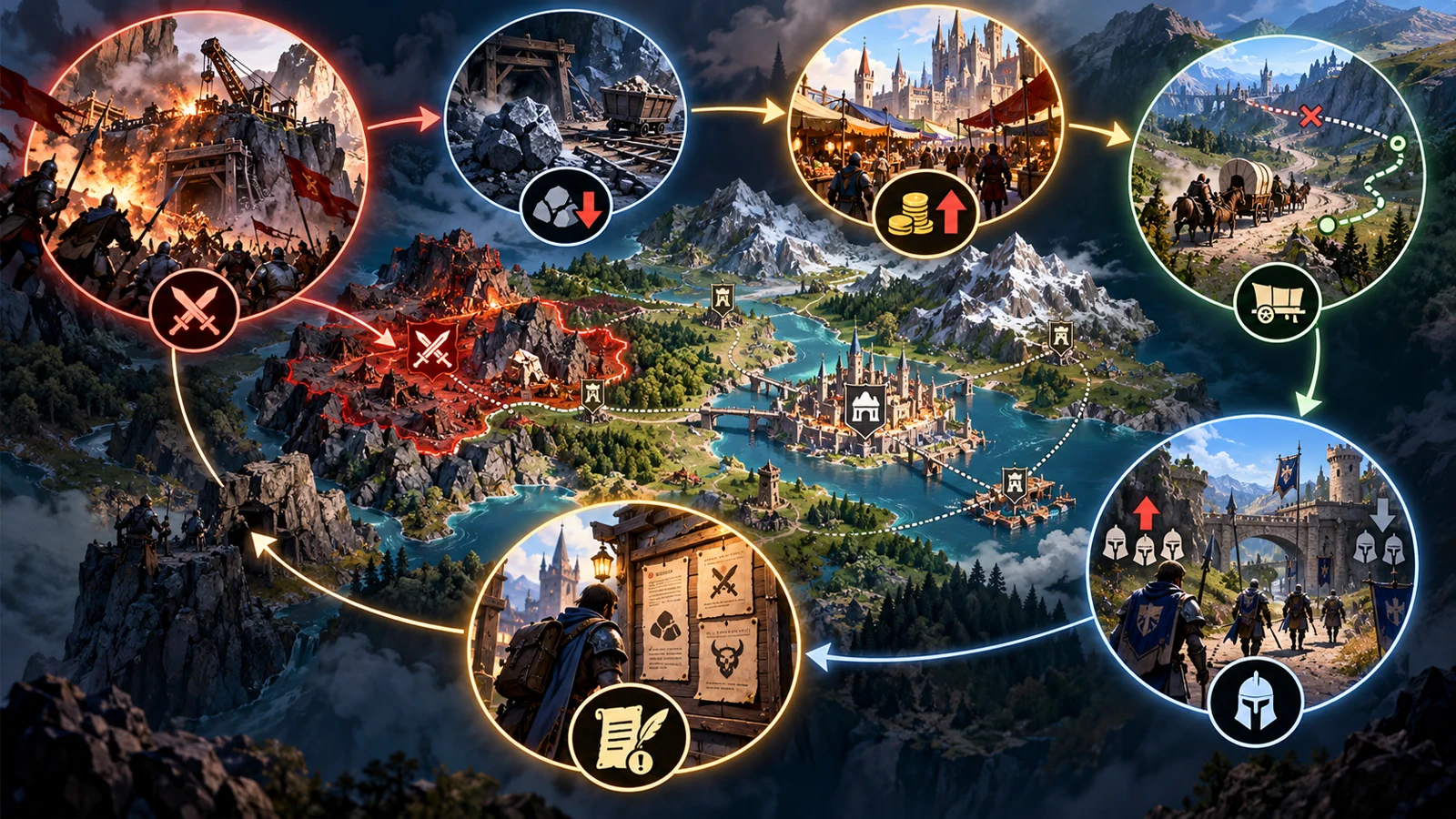
The next major evolution in MMORPGs may not be a better graphics engine or simply a larger map. It could come from the ability of different systems to communicate with one another. A fictional example illustrates this potential:- a player faction attacks a mining region;
- ore production decreases;
- weapon prices rise in nearby cities;
- merchants adapt their activities;
- guilds organize new trade routes;
- NPCs talk about the conflict and change their behavior;
- new missions appear in response to the situation.
Final Fantasy XIV and World of Warcraft also show that a living world does not depend solely on technology
To follow the announced evolution of Azeroth, also see our update on WoW Forever and Blizzard's announcements at BlizzCon 2026.
However, it would be reductive to view innovation solely through a technical lens. MMORPGs such as Final Fantasy XIV and World of Warcraft still rely heavily on content designed and controlled by their developers. Their longevity shows that:- the quality of the universe;
- social relationships;
- guilds;
- events;
- regular updates;
- and community trust
Guild Wars 3: a new project, with a beta announced for 2027
ArenaNet announced Guild Wars 3 on June 5, 2026, for PC, Steam and PlayStation 5. The publisher places its first beta in fall 2027, without yet giving a release date or detailing all of the game's systems. The project shows that new MMORPGs remain in development, but it is too early to draw conclusions about world persistence, player economies or the use of AI.
Conclusion: the future of MMORPGs will probably be hybrid
The future of MMORPGs therefore comes down neither to artificial intelligence, nor Web3, nor ever-larger maps. The most credible avenues today are a combination of:- more persistent worlds;
- economies in which players have greater influence;
- events capable of reacting to the server's overall state;
- more context-aware NPCs;
- AI used as a complement to writers and game designers;
- social systems capable of creating their own stories.
FAQ — The future of MMORPGs
- What will future MMORPGs look like?
- Next-generation MMORPGs could offer more persistent worlds, economies more strongly influenced by players, dynamic events and NPCs capable of more context-aware reactions through artificial intelligence.
- Is generative AI already being used in MMORPGs?
- It has not yet become standard technology in major MMORPGs. Companies such as Ubisoft and NVIDIA are nevertheless developing prototypes and tools for conversational characters and gaming experiences using generative AI.
- Will NPCs one day remember players?
- This is technically possible through systems combining AI models, databases and game context. The main challenge will be managing this memory at scale while maintaining narrative consistency and data privacy.
- Are NFTs essential to future MMORPGs?
- No. Games such as EVE Online already have complex economies strongly influenced by players without using blockchain. NFTs are a possible technology for certain uses, not a requirement.
- Does an NFT really allow you to own an in-game item?
- It can represent ownership of a digital asset on a blockchain, but the rights linked to the item, its use and its continued presence in a game remain defined by the publisher and the applicable terms.
- Will it be possible to transfer items from one MMORPG to another?
- This kind of interoperability remains highly complex. Each game must recognize the item, have the necessary graphical assets, integrate it into its rules and possess the corresponding rights. Blockchain does not solve these problems on its own.
- Which MMORPG already has a genuine player economy?
- EVE Online is one of the best-known examples. CCP says its market is largely player-driven and that a large share of traded goods is produced by the community.
Official sources
- EVE Online — player-driven economy
- EVE Online — Monthly Economic Report, September 2026
- Ubisoft — NEO NPCs and generative AI
- Ubisoft — technology and Teammates
- NVIDIA — ACE for Games
- NVIDIA Technical Blog — KRAFTON and PUBG Ally, June 2026
- Ubisoft — Teammates, playable research experience
- Ashes of Creation — alpha status and announced dynamic systems
- Pax Dei — social sandbox MMO vision
- NVIDIA Technical Blog — ACE and Nemotron 3.5 Bolt, October 27, 2026
- Latitude — Voyage launch, August 26, 2026
- NCSoft — Guild Wars 3 announcement, June 2026