Pragmata is finally available, and Capcom can breathe a sigh of relief: the riskiest and most mysterious gamble in its catalog has turned into a critical and commercial success. Released on April 16, 2026, the game immediately won over the specialist press with a Metacritic score of 86/100, confirming that the six-year wait was worth it. The key takeaway: Pragmata is available now on PS5, Xbox Series X|S, Nintendo Switch 2 and PC, priced at €59.99 (or €69.99 for the Deluxe Edition).

Pragmata essentials
- Genre: Action-adventure / science fiction / third-person shooter.
- Platforms: PlayStation 5, Xbox Series X|S, Nintendo Switch 2 and PC (Steam).
- Release date: April 16, 2026 (available now).
- Critical score: 86/100 on Metacritic, 87/100 on OpenCritic.
- Graphics engine: RE Engine (the same engine used for Resident Evil and Street Fighter 6).
- Price: €59.99 (standard edition) / €69.99 (Deluxe Edition). A free “Sketchbook” demo is available.
From announcement to release: Capcom’s successful gamble
Unveiled during the PlayStation 5 reveal event in June 2020, Pragmata immediately intrigued the community with its distinctive art direction. The game then received very little communication for several years, with an indefinite delay announced in June 2023 that raised serious concerns about the project. Six years after its announcement, Capcom finally released the game on April 16, 2026, alongside a playable demo called “Sketchbook” that lets players try the combat system before buying. The result exceeds expectations: the international press describes it as one of the best games of the first half of 2026, alongside other Capcom releases this year such as Resident Evil Requiem and Monster Hunter Stories 3: Twisted Reflection.Pragmata’s opening hours: a gripping introduction
It begins with silence. A lunar research base, funded to exploit an ore capable of powering industrial-scale 3D printers, suddenly stops transmitting. No explosion, no warning—just nothing. This absence of a response, more unsettling than any announced disaster, opens Pragmata—and from the first minutes, the game establishes a tension that never truly lets up. You play as Hugh Williams, sent with his team to discover what has reduced the station to silence. The journey is calm, almost routine. Too calm. Then a lunar earthquake strikes, and within seconds, a routine expedition turns into a fight for survival: Hugh finds himself alone and isolated in a facility that no longer responds to human commands—because an artificial intelligence has taken control.A meeting that changes everything
It is amid this chaos that Diana appears. Neither an enemy nor a merely programmed ally, she is an android with the appearance of a young girl who saves Hugh at the last moment and forms an improvised survival pact with him. The game does not waste time explaining who she really is—it lets you discover her gesture by gesture while the two of you learn to navigate a hostile base that seems to watch you from every corridor. It is precisely during this first hour that Pragmata makes its greatest promise: you will not simply accompany Diana; you will have to think with her in real time to survive.The first battle: when stress becomes exhilarating
The first confrontation with a security robot is a pivotal moment—and this is where the game’s signature mechanic hits hard. Hugh shoots, dodges and searches for cover; meanwhile, you must activate Diana’s hacking to bring up a grid and trace a path to an exit node, or leave the enemy completely invulnerable. The left stick remains occupied with moving the duo out of the line of fire, while the buttons direct the hack. Two tasks, one pair of hands and a single fraction of a second to avoid taking a hit. The result resembles nothing Capcom has produced before: neither the pure action of Devil May Cry nor the tactical horror of Resident Evil, but a genuine mental whirlwind where every second of hesitation comes at a steep price. Early testers were not mistaken: this friction—demanding but never punishing—is precisely what earned the game its most unanimous praise.A lunar base that tells the story of its own downfall
Between encounters, Pragmata gives you time to breathe—and this may be the strongest part of the game’s opening. The station’s corridors are not mere scenery: they are frozen crime scenes. Abandoned personal effects, unfinished messages and areas where the 3D printer continued operating with no one left to collect what it produced. You are not told what happened; you are left to reconstruct it piece by piece, with the growing sense that the real threat may not be the one you are fighting with a firearm.It is this rare combination—a gameplay system that keeps you under constant pressure and a narrative that dispenses its mystery drop by drop—that makes Pragmata’s first two hours one of the most accomplished openings of 2026. Once the controller is in your hands, it is difficult to put it down before understanding what really doomed this base.
Gameplay: a two-brain combat system
Pragmata is a third-person action game whose originality lies in controlling two characters simultaneously with a single player: Hugh and Diana.Hugh and Diana, an inseparable duo
You play as Hugh, a member of an investigation team sent to a lunar base that has fallen under the control of a rogue AI. After an accident, Hugh is rescued by Diana, a young android capable of hacking enemy systems. The player manages Hugh’s movement, shooting and jumps while simultaneously directing Diana’s hacking abilities—a mechanic the press found demanding but particularly rewarding once mastered.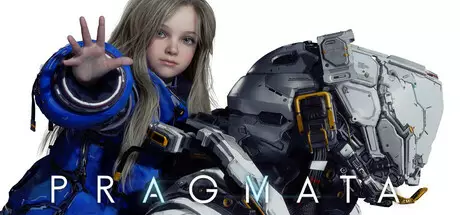
Combat and exploration of the lunar base
Encounters pit the duo against robots and security drones controlled by the station’s AI. Diana’s hacking can disable enemy defenses while Hugh provides ground cover, creating a gameplay loop that combines shooting, resource management and real-time puzzle solving. The adventure, centered on a linear narrative experience lasting around eight hours, takes place on a research base filled with traces of its former inhabitants. The only drawback noted by several testers is a sometimes frustrating checkpoint system and a pace that loses a little momentum during the final third of the adventure.Technical ambition and art direction
Pragmata stands out with a “NASA-punk” aesthetic blended with more dreamlike science fiction. The RE Engine delivers a level of realism unanimously praised by the press, particularly in:- Facial animation: the exchanges between Hugh and Diana are driven by expressiveness noted by numerous testers.
- Texture quality: highly detailed rendering of materials such as metal, glass and spacesuits.
- Sound design: a carefully crafted contrast between the silence of space and the chaos of combat.

A strategic success for Capcom
Pragmata is Capcom’s first new AAA IP outside its established franchises (Resident Evil, Monster Hunter) in many years. The gamble has paid off: beyond its critical reception, the game sold more than one million copies in 48 hours and forms part of an exceptional 2026 for the publisher, alongside Resident Evil Requiem and Monster Hunter Stories 3.Our verdict: Pragmata confirms that Capcom can also shine outside its usual franchises. The two-character combat system is the studio’s best gameplay idea in years, supported by a Hugh/Diana relationship that is rare in its emotional impact. We only regret an imperfect checkpoint system and a slightly overlong ending. Score: 17/20.
Pragmata: True Ending, Crystals and Keys – The Complete Lunar Guide
The asymmetrical combat system and exploration of the Delphine Corporation space station conceal many secrets that are essential for completing the adventure 100%. If you are stuck in the lunar station or curious to uncover the story’s mysteries, this progression guide provides every solution validated by our editorial team.🎬 Pragmata: Ending explained and how to unlock the “True Ending”
The conclusion of Pragmata leaves many questions unanswered about the fate of our duo.The finale explained (Spoilers)
At the end of the roughly eight-hour linear adventure, we discover that the rogue AI did not seek to eliminate the crew out of pure malice, but to protect a major secret: Diana is not a simple maintenance android. She is the cornerstone of an Earth terraforming program. In the standard ending, Hugh sacrifices himself so Diana can send the data to Earth, leaving her alone on the Moon.Step-by-step guide to the Hidden Ending (“Secret Ending”)
There is, however, a much more positive alternate ending in which Hugh and Diana both survive. To unlock this Pragmata true ending, you must fulfill three requirements before passing the final chapter’s point of no return:- Max out the Refuge: You must complete every Bingo mini-game grid available at the Refuge terminals.
- Upgrade the Eraser: Your cleaning tool must be upgraded to level 3 to decode Hugh’s team’s final radio message.
- Purify all 9 zones: No red zone may remain on your map before taking the orbital elevator.
🗺️ Red Zone Guide: Where to find and destroy every Crystal
Purifying the station is the core of the game’s secondary content. It provides the materials needed for Hugh’s best armor upgrades.[Lunar Station Progress Map]
• [Research Sector] --> 3 Blue Crystals
• [Crew Quarters] --> 2 Red Crystals
• [Storage Bay] --> 4 Mixed Crystals
Mastering the Eraser
To clean the corruption, you must use Hugh’s secondary weapon, called the Eraser. Blue crystals break under a continuous charged shot, while red crystals require Diana to first apply an overload hack to the nearby grid to expose their weak point.Locations of the 9 Corrupted Zones
- Zones 1 to 3 (Research Sector): Hidden behind the ventilation ducts of the main laboratory. Use Hugh’s jetpack to reach them.
- Zones 4 and 5 (Crew Quarters): Located in the abandoned cafeterias. Beware: activating the cleaning process triggers a wave of aggressive security drones.
- Zones 6 to 9 (Storage Bay): These four zones surround the industrial 3D-printing area. Consult your terminal’s interactive map so you do not miss the crystal suspended from the ceiling of the central tank.
🔑 Pragmata security keys: How to open every red door
Throughout your exploration, you will encounter armored airlocks marked by a bright red indicator. These doors require specific security keys, often hidden far from their corresponding locations.- Alpha Sector Key: Located in the supervisor’s office, beneath a pile of textured documents. It opens the door leading to the advanced ammunition stores.
- Laboratory Key: Obtained automatically after successfully completing the real-time hacking puzzle in the server room.
- Progression tip: When you insert a key, the enemy AI systematically attempts to lock the airlock. Focus on Diana’s grid mini-game with the buttons while moving Hugh with the left stick to dodge the defensive turret fire activating behind you.
🎮 Refuge Bingo mini-game: Tips for unlocking the best rewards
The Refuge is not merely a place to rest; it is where you can play Pragmata’s Bingo mini-game on the onboard computers.- The concept: Every zone cleaned on the Moon gives you data tokens. Spend them to align code vectors on a 5x5 grid.
- The ultimate tip: Do not try to fill straight lines first. Aim for the four corners of the grid to trigger an “Overload” bonus, which doubles the research points earned.
- Exclusive rewards: This is the only way to unlock Diana’s “Overclock” hacking module, reducing puzzle-solving time in combat by 30%.
💻 Pragmata Sketchbook demo: Tips for mastering the duo gameplay
If you have not yet taken the plunge and bought the €59.99 game, the free “Sketchbook” demo available on PC via Steam offers an excellent training ground.- What the demo includes: It gives you access to the entire first chapter, including the combat tutorial and the first robotic boss.
- PC setup advice: Since the “two-brain” gameplay is highly demanding, we strongly recommend playing with a controller. If you play with keyboard and mouse, assign Diana’s hacking functions to your mouse’s side buttons so you never have to release Hugh’s movement keys (WASD).