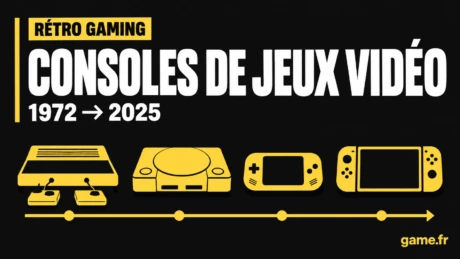
Quick answer: The Magnavox Odyssey, first sold in the United States in 1972, is generally recognized as the first commercially released home console. There is no universally agreed number of console generations: the commonly used home-console breakdown is a historical guide, while handheld and hybrid systems follow developments that are harder to align. This guide connects the major machines with eight brand histories.
A console is defined as much by its games, format, controls, and use as by its power. The same machine can also launch at different times in different countries. We therefore give its first commercial launch and region, and point out local names where that helps avoid confusion.
What was the first video game console?
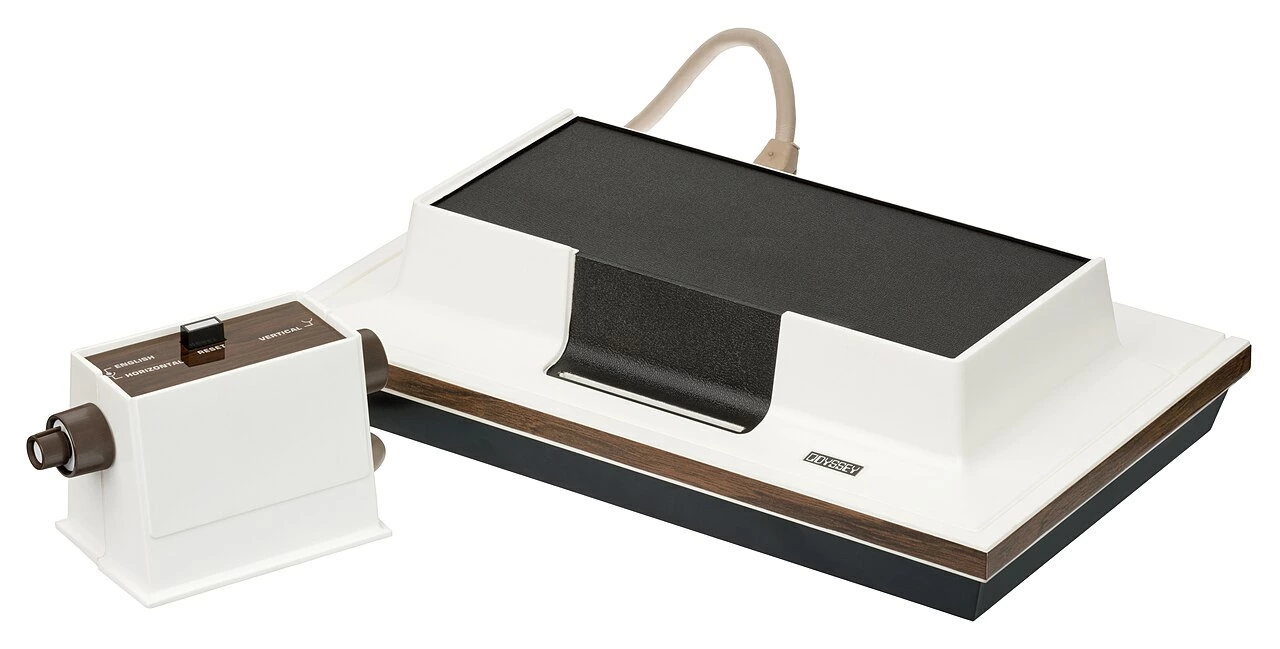
The 1972 Magnavox Odyssey is the answer when it comes to a commercially released home console. It does not run programmed cartridges like later machines. Atari's Home Pong then popularized dedicated games played on a television, while the 1977 VCS/2600 helped establish the idea of a library of games on cartridges. The first device, then, is not necessarily the one that established the dominant commercial model.
A timeline from 1972 to 2025
This timeline highlights turning points rather than every variation released. The manufacturer-by-manufacturer rows in Barwin's Timeline inspired the brand-based approach, without reproducing its poster. The Culture Games page on console generations rightly points out that classifications are proposals, and that handhelds do not fit neatly into a simple one-to-one comparison with home consoles.
1976: the Fairchild Video Entertainment System, later called Channel F. Following the Odyssey, this American console introduced interchangeable games on programmed ROM cartridges, ahead of the Atari VCS/2600. The Computer History Museum documents this milestone. To find machines year by year, see our list of video game consoles by release date.
How many console generations are there?
People commonly refer to nine major periods for home consoles, up to the PS5 and Xbox Series, but their boundaries are not shared official dates set by every manufacturer. Some machines launch late in one period while extending the architecture of the previous one. Counting "bits" was already an imperfect measure in the cartridge era, and it no longer explains modern generations. The hybrid format of the Switch and Switch 2 makes it even harder to align them with Sony and Microsoft's schedules.
Why does Culture Games show a "10th generation"? Its infographic proposes an additional breakdown starting in 2022. That is neither a shared manufacturer launch date nor an official standard: the PS5 and Xbox Series have been on sale since 2020, while the Switch 2 launched on June 5, 2025. Our guide to nine home-console periods, with separate histories for handheld and hybrid systems, is therefore an explicit editorial choice that readers can compare with the Culture Games proposal.
Three ways to trace the history
Home consoles
Home consoles have moved from devices with built-in games to cartridges, then discs, downloads, and connected services. The Odyssey, Atari 2600, Famicom, Mega Drive, PlayStation, Xbox, and PS5 mark key stages along the way. Adding a CD player to an existing console does not automatically create a new platform; the game library and base machine need to be considered.
Handheld consoles
Portability brings different trade-offs: screen, batteries or battery life, size, controls, and games designed for the format. Game & Watch, Game Boy, Lynx, Game Gear, Neo Geo Pocket, DS, PSP, 3DS, and PS Vita cannot be neatly classified solely by the power of a contemporary home console. Some are devices with built-in games; others are full-fledged cartridge- or disc-based platforms.
Hybrid consoles
The 2017 Switch combines TV and portable play in a single platform. The Switch 2, launched in 2025 according to Nintendo, continues this format as a new hardware family. The Switch Lite is a handheld version of the original Switch: it is not a third hybrid generation.
The innovations that changed consoles
| Innovation | Iconic console or family |
|---|---|
| Interactive home gaming on a television | Magnavox Odyssey (1972) |
| Interchangeable programmed ROM cartridges | Fairchild Channel F (1976) |
| Wider adoption of cartridge-based handheld gaming | Game Boy (1989) |
| Growth of mainstream 3D gaming | PlayStation (1994) |
| DVD playback on a console | PlayStation 2 (2000) |
| Online gaming built into a console ecosystem | Xbox and Xbox Live (2002) |
| Hybrid home and handheld console | Nintendo Switch (2017) |
Explore the eight brands
| Brand | Its place in the timeline |
|---|---|
| Magnavox | The Magnavox Odyssey opens the history of home consoles. Find out how the lineup developed through the Odyssey² and Europe's Videopac. |
| Atari | From Home Pong to the Jaguar, Atari consoles accompanied some of the first major transformations in home gaming. |
| Nintendo | From its first TV games to Switch 2, Nintendo has built families of home, handheld, and then hybrid consoles. |
| Sega | Sega made home consoles and a handheld before leaving the consumer hardware business. |
| NEC and Hudson | NEC and Hudson developed a distinctive console lineup, from the PC Engine to the PC-FX. |
| SNK | The AES brought the arcade experience closer to home; Neo Geo CD and Pocket later extended the brand into other formats. |
| PlayStation | Sony moved from the original PlayStation's CD format to online services, handhelds, and the PS5. |
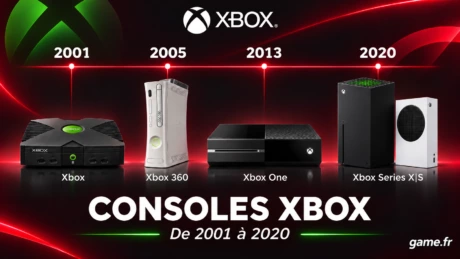
| Xbox | Since 2001, Xbox has built four main console families, from its first machine to the Series X and S. |
Coleco, Mattel, Bandai, and 3DO are part of the broader history. This first series does not yet have a dedicated guide for them; their absence from the table does not mean they were absent from the market. Conversely, a brand that appears several times in the timeline can encompass machines with very different roles.
Console, revision, accessory, or re-release?
A new console generally has its own hardware proposition and an identifiable library. A revision, such as a Slim model or an enhanced version, normally belongs to an existing family. A Mega-CD or CD-ROM² is an add-on; a modern 2600+ revisits an older catalog. These categories can be debated at the margins, but distinguishing them makes the overview more useful than simply piling up commercial names.
Why the same console can have multiple release dates
A timeline limited to a single year can hide a gap of several months or years between regions. Nintendo dates the Famicom's Japanese release to 1983, but the NES's European release to 1986 in its official history. The first Xbox arrived in North America in November 2001, then in Europe in March 2002, according to Xbox Wire France. The Dreamcast launched in Japan in November 1998 and in Europe in October 1999, according to the Centre for Computing History. That's why the tables in this guide give the first market and clarify name or regional changes where useful to French readers.
Generational classifications say even less about how people played: dice and cards accompanied the Odyssey, Famicom disks could be rewritten, and some Neo Geo saves could travel between home and arcade. These examples, checked against the brand guides, show what a timeline alone leaves out.
Frequently asked questions
What was the first home console?
The Magnavox Odyssey, sold in the United States in 1972, is the most widely accepted answer.
Do the Game Boy and NES belong to the same generation?
Their uses, technical constraints, and release schedules differ. It is clearer to follow Nintendo's handheld and home-console lineages separately.
Do the PS5 Pro or Switch Lite start a new generation?
Not in this guide: they are presented as variants of their respective console families. Switch 2, by contrast, is a new console.
Sources and methodology
Dates refer to the first commercial launch, with the region specified. Variants of the same hardware are grouped together; dates may differ by country. Verified: November 11, 2026.